
Lasers can be used to cool as well as heat materials, a phenomenon demonstrated in 2015 by University of Washington researchers by refrigerating saline solution and cell culture media used in genetic research to below room temperature. The researchers recently applied a similar approach to the refrigeration of a solid semiconductor.
An infrared laser was used to cool a solid semiconductor optomechanical resonator by at least 20° C below room temperature. A hydrothermally synthesized ytterbium: yttrium lithium fluoride microcrystal was attached to a cantilever device and suspended in vacuum as the target for the laser beam. Absorption of energy by 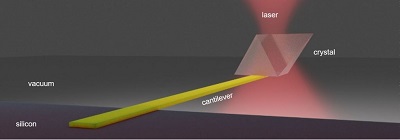 An infrared laser was used to cool a solid semiconductor material by at least 20° C below room temperature. Source: Anupum Pant / University of Washingtonytterbium from the crystal caused a blueshift glow effect that cooled the ceramic crystal and the attached semiconductor device.
The light emitted by the crystal shifted on average to longer wavelengths as with an increase in laser power, which indicated cooling. The refrigeration effect, evident as a 20° C drop below room temperature, took less than 1 millisecond and lasted as long as the excitation laser was on.
The method of solid-state refrigeration described in Nature Communications offers opportunity to improve the sensitivity of optomechanical resonators and expand their applications in consumer electronics, lasers and scientific instruments.
