
Researchers from the University of Sydney created a method that uses durian and jackfruit for rapid electricity charging.
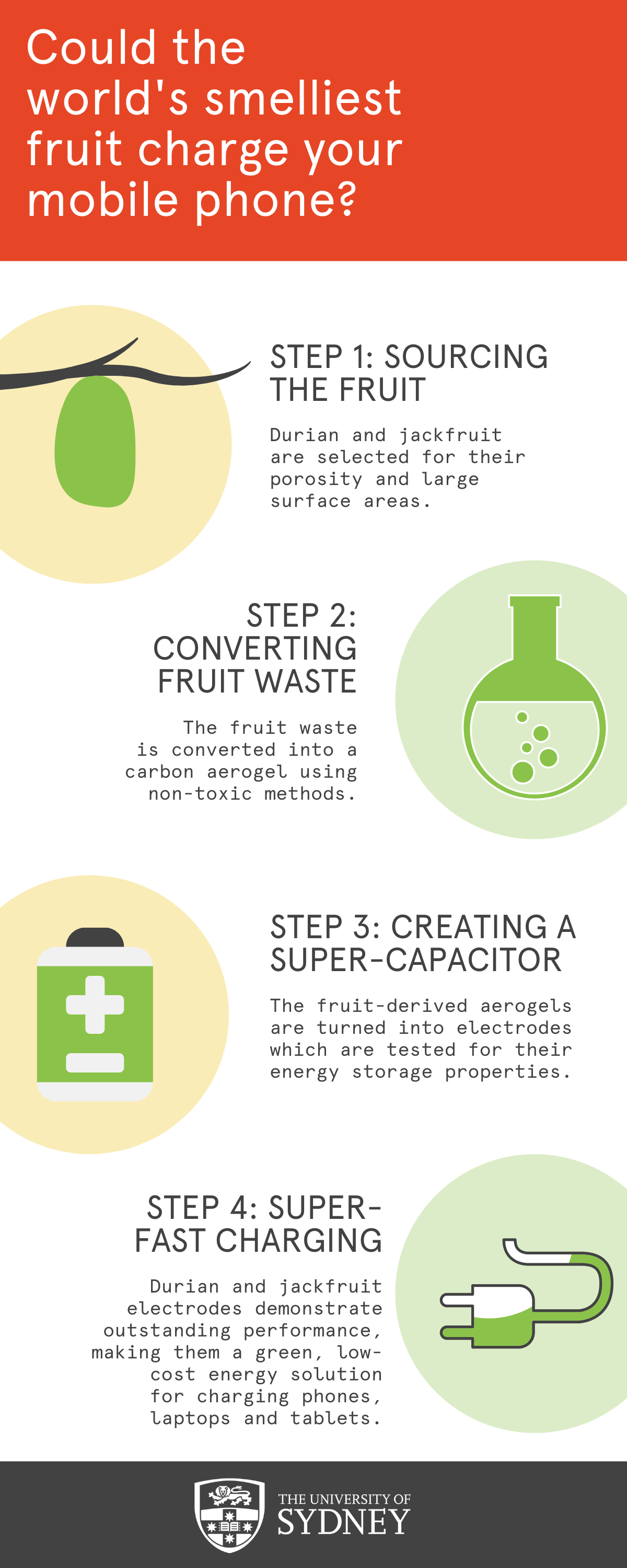 Source: University of SydneyDurian waste is very smelly, and once the fruit is peeled, people want to get rid of it as soon as possible. Yet, instead of throwing the waste away in a landfill, the team wanted to use it to create zero waste supercapacitors.
Durian fruit offers a suitable template for creating porous aerogels. The fruit’s biomass can be converted into supercapacitors that can store electricity through a green, non-toxic, non-hazardous method. This was achieved by heating the biomass in water then freeze-drying it to create stable carbon aerogels, a light, porous synthetic material for highly porous supercapacitors.
The team used the fruit-derived aerogels to make the electrodes and when those electrodes were tested for energy storage properties, the supercapacitors demonstrated that they could charge the devices quickly.
According to the research team, current supercapacitors are made from activated carbon and are not as efficient as the fruit-based ones.
A paper on this development was published in the Journal of Energy Storage.
