
The next generation of cellular wireless technology 5G is set to expand substantially in 2020 after launching in 2019. Along the way, several new smartphones will be introduced this year to take advantage of expanded deployment and improved coverage in cities.
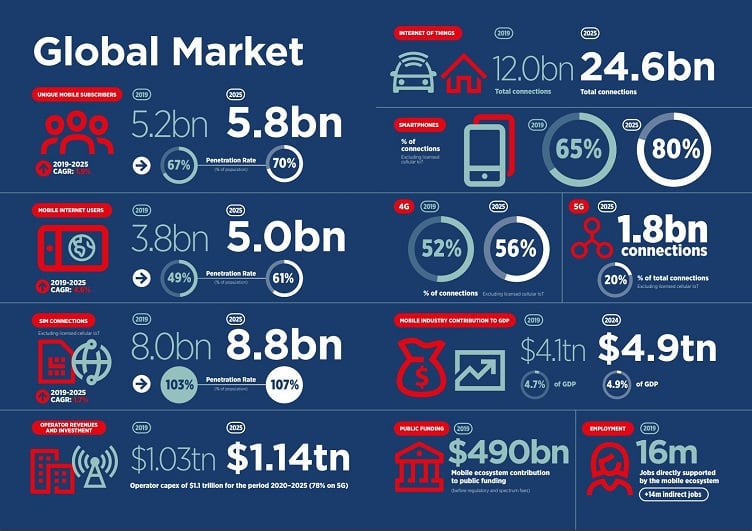
The GSM Association (GSMA), an industry organization that tracks the interests of global mobile network operators and runs the annual Mobile World Congress, released its annual report on the mobile economy for 2020 highlighted by a forecast that 1.8 billion 5G connections will be adopted by 2025.
Among the regions that will have the most 5G subscribers will be Asia Pacific with 50% adoption by 2025 followed by North America with 48% adoption, Europe with 34% adoption and developing Asian regions with 22%.
“The mobile operator worldwide investment forecast will be more than a trillion dollars over the coming years, focused on rolling out advanced networks to serve both consumer and enterprise customers,” said Mats Granryd, director general of the GSMA. “Over the last 12 months we have seen the 5G ‘hype’ make way for reality: millions of consumers are already migrating to 5G, while enterprises are beginning to embrace 5G-enabled network slicing, edge computing and low-latency services.”
5G is here but 4G still rules
5G was launched last year and is now live in 24 markets around the world. GSMA forecasts that 5G will account for 20% of global connections by 2025 with particularly strong adoption in Asia, North America and Europe.
However, 4G remained the dominant mobile technology in 2019 and will continue to be the main technology across the globe, continuing to grow over the coming years and increasing to about 56% of connections by 2025.
5G will bring $2.2 trillion to the economy
The GSMA said mobile technologies and services generated 4.7% of global GDP last year, accounting for $4.1 trillion of the global economy. This is expected to grow to $4.9 trillion by 2024 and in the next 14 years will contribute $2.2 trillion to the global economy.
Key industries that will contribute to this growth will be manufacturing, utilities and professional and financial services.
IoT will be very important to 5G
Between 2019 and 2025, the number of global internet of things (IoT) connections will double to nearly 25 billion with revenue from IoT more than tripling to $1.1 trillion.
Speed is important
While only 59% of people have heard about the 5G network rollout, those who have feel the biggest benefit of 5G is improved mobile data speeds. GSMA said that because of this, carriers need to work on highlighting other benefits of 5G such as improved fixed home broadband and improved mobile service coverage.
Other benefits may be seen over time as 5G promises to usher in a number of new use cases for cellular wireless such as improving emergency services, bringing 8K media content to life, enabling robots to go farther in the field, enhancing smart agriculture and even helping develop autonomous vehicles.
Enterprise connections will expand
Enterprise IoT connections will overtake consumer connections by 2024 and is forecast to triple between 2019 and 2025 to reach 13.3 billion, GSMA said. By this time, 5G will become the first cellular generation in history to have a bigger impact on enterprise than consumers.
Learn more about the GSMA’s findings with the Mobile Economy report.
