
An initial indication of cardiac arrest is agonal breathing, or the cessation of breathing and gasping for air. 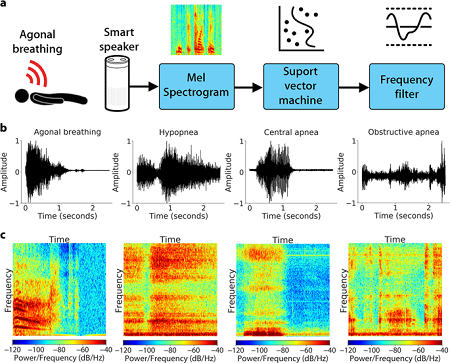 Using a smart speaker to detect agonal breathing. a) Agonal breathing detection pipeline, b) audio waveform and c) spectrogram of agonal breathing, hypopnea, central apnea and obstructive apnea. Source: University of WashingtonImmediate intervention can increase survival chances, but research suggests that a common location for an out-of-hospital cardiac event is in a bedroom where the patient is alone. Now, with smart speaker and AI capabilities, people can be monitored for signs of cardiac distress while they sleep.
University of Washington researchers developed an algorithm that identifies agonal breathing with a high degree of accuracy. The technology can be embedded into a variety of listening devices such as smart speakers or smartphones to alert emergency personnel and family members if someone is having a heart attack while they sleep. The proof-of-concept tool was developed using real agonal breathing instances captured from 911 calls and tested with Amazon Echo and Apple iPhone. The approach successfully detected agonal breathing events 97% of the time from up to 20 ft (6 m) away.
The researchers envision designing a continuous, passive monitor capable of summoning anyone in the vicinity for help if agonal breathing is detected, or otherwise automatically connecting to emergency services.
A research paper is published in Npj Digital Medicine.
