
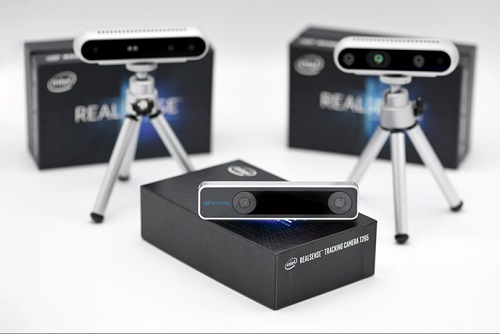
 The Real Sense Tracking Camera T265. Source: Intel
Intel has introduced a new tracking camera that uses visual inertial odometry simultaneous localization and mapping (V-SLAM) technology for applications such as robotics drones, augmented reality (AR) and virtual reality (VR).
The Real Sense Tracking Camera T265 uses Intel’s Movidius Myriad 2 vision processing unit (VPU) that directly handles the data processing necessary for tracking on the device.
The device works where GPS service can’t be relied on such as in warehouses or remote outdoor areas where the camera uses a combination of known and unknown data to navigate to its destination. The T265 is lightweight with a small footprint making it applicable for robots and drones, but has connectivity to be used with smartphones or AR headsets.
Intel uses an example of incorporating the T265 into a robot designed for agriculture that allows it to navigate fields in a precise lawn-mower style pattern and avoid obstacles in its environment. It could also help in drone delivery where destinations are remote or off-the-grid.
Intel said the camera does not rely on any external sensors to understand its environment, instead using inside-out tracking by gathering inputs from two onboard fish-eye cameras, each with an approximate 170° range of view. The V-SLAM systems construct and update maps of unknown environments and the location of a device within those environments.
