
Electricity can be beneficial for skin healing, but most electrotherapy units in use require bulky equipment and complicated wiring to deliver powerful jolts of electricity. A more practical application for electric stimulation therapy has been advanced as a bioshock bandage that helps wounds to heal by delivering small electrical pulses.
The bandage engineered by an international team of researchers consists of small electrodes for the injury site 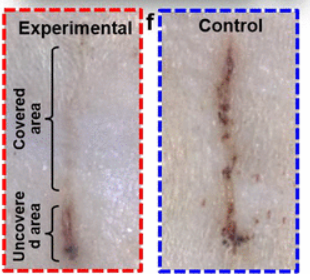 Digital image of wound recovery after two days in both experimental (red rectangle) and control (blue rectangle) rat model groups. Source: University of Wisconsin-Madisonlinked to a band equipped with energy-harvesting nanogenerators. These are looped around the wearer’s torso, with the natural expansion and contraction of the ribcage during breathing powering the low-intensity pulses.
Tests with rodent models demonstrated that the bioshock bandage reduced healing time from 12 to just three days. The low-power pulses won’t harm healthy tissue like traditional, high-power electrotherapy devices might. Exposing cells to high-energy electrical pulses can cause the production of almost five times more reactive oxygen species — major risk factors for cancer and cellular aging — than cells were exposed to the nanogenerators.
The low-power pulses were also observed to increase viability for fibroblasts, and exposure to the nanogenerator’s pulses encouraged fibroblasts to align, which is a crucial step in wound healing, and produce more biochemical substances that promote tissue growth.
Further research will expand nanogenerator capabilities by permitting energy harvesting from imperceptible twitches in the skin or the thrumming pulse of a heartbeat and to reproduce results in human skin models.
Scientists from the University of Wisconsin-Madison, the University of Electronic Science and Technology of China and Huazhong University of Science and Technology (China) contributed to this study, which is published in ACS Nano.
