The occurrence of harmful algal blooms is increasing worldwide, according to the U.S. National Oceanographic and Atmospheric Administration. High water temperature attributed to climate change, along with increased nutrient levels from fertilizer use, spur bloom growth, resulting in oxygen depletion, ecosystem degradation and threats to human health.
Efforts to map phytoplankton occurrence and composition are time-consuming, involving water sampling and laboratory analysis. Algal assemblage in a given body of water can change quickly, even in the time it takes to analyze samples.
An inexpensive, portable device that can analyze water samples immediately could provide researchers with 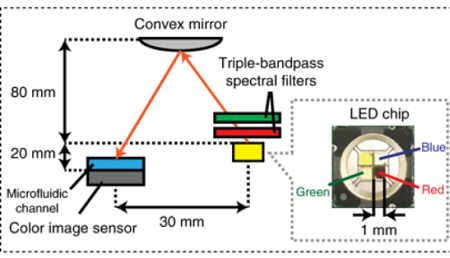 Schematic of the imaging flow cytometer device. Source: UCLAreal-time insight about the potential formation of algal blooms. Such information would help managers of coastal areas to make better, faster decisions about closing beaches and shellfish beds before blooms cause serious damage.
Such a device engineered at the University of California Los Angeles (UCLA) detects and measures the physicochemical characteristics of objects within a sample, based on holographic imaging and artificial intelligence. The flow cytometer analyzes the composition of various plankton species within seconds.
No lenses or other optical components are used, bringing the cost of the compact device down to $2,500, far less expensive than the $40,000 to $100,000 outlay for commercially available imaging flow cytometers.
Commercially available imaging flow cytometers used in environmental microbiology can cost from $40,000 to $100,000, which has limited their widespread use. The UCLA cytometer is compact and lightweight, and it can be assembled from parts costing less than $2,500.
The instrument was used to image phytoplankton along the Los Angeles coastline and to measure the concentration of a potentially toxic alga along six public beaches in the region. These measurements were comparable to those in a recent study by the California Department of Public Health's Marine Biotoxin Monitoring Program.
The research is published in Light: Science & Applications.