
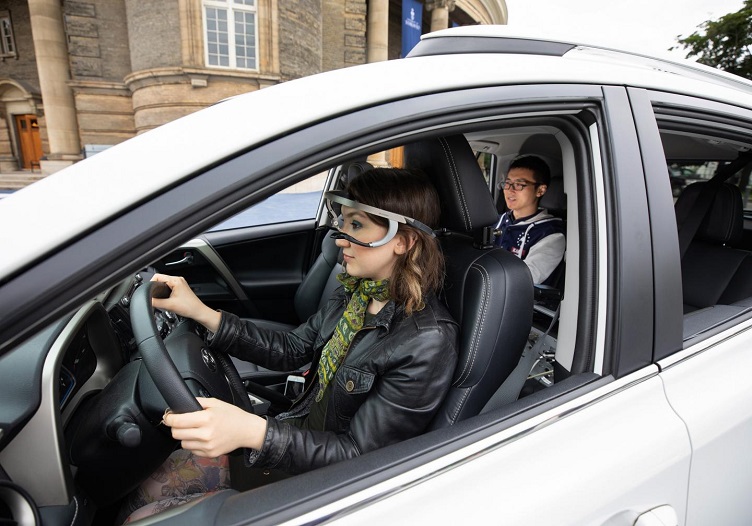
Researchers at the University of Toronto have studied the eye movements of drivers at busy Toronto intersections to determine if drivers make the necessary scans to look for pedestrians or cyclists during right turns.
The university, using eye-tracking equipment to accurately assess where drivers were looking when turning at an intersection, found that more than half failed to look for these road elements as they turned right.
"There are a lot of visual and mental demands on drivers at intersections, especially in a dense, urban environment like downtown Toronto," said Nazli Kaya, a University of Toronto student working with Professor Birsen Donmez, Canada Research Chair in Human Factors and Transportation on the research. "Drivers need to divide their attention in several directions, whether it's other vehicles, pedestrians or road signs and traffic signals — traffic safety instantly becomes a major concern.”
The research found that 11 of the 19 drivers tested failed to gaze at an area of importance where cyclists and pedestrians are located before turning. These people did not make frequent over-the-shoulder checks for cyclists, and more failures were made on busy streets due to parked vehicles blocking drivers’ views of the bike lane. The study also found more failures were made with those people who frequently drove in downtown Toronto.
"The results were quite surprising," Donmez said. "We didn't expect this level of attention failure, especially since we selected a group that are considered to be a low crash-risk age group."
In order to improve traffic safety, changes in road infrastructure are needed to make bike lanes more predictable and easier to see, Donmez said.
"The takeaway for pedestrians and cyclists: drivers aren't seeing you. Not necessarily because they're bad drivers, but that their attention is too divided," Donmez said. "When crossing a street, your assumption should be that the car doesn't see you."
