
Inductor and transformer manufacturer ITG Electronics now offers a range of common footprints, as well as 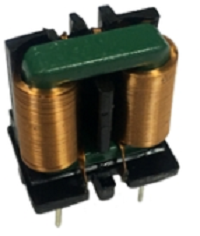 Source: ITG Electronicscustom flat-wire common mode chokes (CMC) for high power density and high-frequency switching.
Flat-wire CMCs utilize a flattened, rectangular cross-section, copper wire instead of a traditional, circular cross-section wire. The primary advantage is a greater surface area. At high frequencies, the current penetrates and utilizes less and less of the volume of the copper wire. This is called the skin effect because at high frequencies only the "skin" of the wire is utilized. Flat wire maximizes usable wire at high frequencies due to increased surface area.
This advantage has rippling effects through other aspects of the CMC performance as well. In general, the higher the frequency, the lower the permissible current through a specific wire, again, due to the skin effect, because the current is not utilizing all of the available wire. This means part of the wire is wasted, driving up resistance and heat in addition to lowering the current rating. With a flat-wire CMC, all these effects are stifled as the current is able to use the whole wire more efficiently. The altered geometry of the wire also allows for a much lower distributed capacitance at high frequencies. This enables the choke to have higher impedance over a higher range of frequencies and therefore better performance as a choke.
Flat-wire CMC’s not only use current more efficiently, they use space more efficiently. A flat wire can easily exceed window fill and winding density of its round wire counterparts. Changing core geometry from a traditional toroid to the rectangular core pictured above can yield savings of up to 50 percent in volume for the exact same performance. Putting it all together, the result is a high energy density part that takes up less space, uses less power, and can operate at a higher frequency.
