
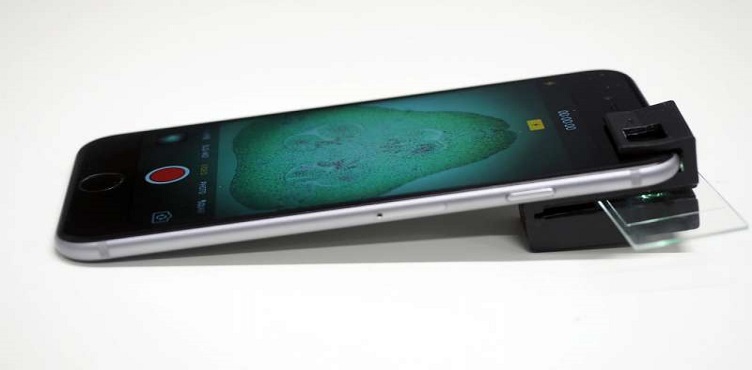
Anyone can now convert their smartphone into a fully functional microscope with a 3D printable clip-on attachment designed at Royal Melbourne Institute of Technology (RMIT), Australia. The researchers are sharing the 3D printing files publicly so anyone with access to a 3D printer can take advantage of the new technology.
The smartphone microscope is powerful enough to visualize specimens as small as 1/200th of a millimeter, such as micro-organisms and blood cells. Conveniently, the clip-on device needs no external power or light source as it has been engineered with internal illumination tunnels that guide light from the camera flash to illuminate the sample from behind. The researchers say this overcomes issues experienced with other microscopy-enabled mobile phone devices.
The clip-on supports both bright-field and dark-field microscopy techniques to be undertaken, resulting in a simple but powerful tool ideal for use in remote areas and for field-work where larger standalone microscopes are unavailable or impractical. Suggested uses include water quality monitoring, blood analysis and disease detection in developing areas.
The research has been published in Scientific Reports.
