
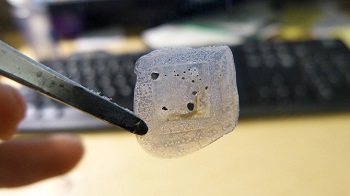
 A polycarbonate shell 125 microns thick after a vaporization test of its embedded rubidium and sodium bifluoride. The chemicals are capable of vaporizing thinned silicon-dioxide microchips packaged in the shell. Source: Cornell University
A new electronic architecture has been developed for those who need to protect sensitive data. A silicon-dioxide microchip self-destructs by vaporizing — an action that can be remotely triggered — without releasing harmful byproducts.
Some transient electronics require moisture to enable dissolution of soluble conductors. Other schemes require use of a heating element and power source so that disintegration occurs at a specific temperature.
Researchers from Cornell University and Honeywell Aerospace engineered a different approach to transient electronics design. A silicon-dioxide microchip is attached to a polycarbonate shell. Microscopic cavities within the shell contain rubidium and sodium bifluoride. When triggered remotely by using radio waves, these chemicals thermally react and decompose the microchip. The radio waves open graphene-on-nitride valves that keep the chemicals sealed in the cavities, allowing the rubidium to oxidize, release heat and vaporize the polycarbonate shell. The sodium bifluoride releases hydrofluoric acid to etch away the electronics.
The technology might also find applications in environmental sensors that can be remotely vaporized once they're no longer needed.
“Our team has also demonstrated the use of the technology as a scalable micro-power momentum and electricity source, which can deliver high peak powers for robotic actuation,” said Amit Lal, professor of electrical and computer engineering.
