
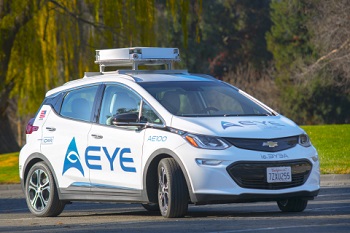
 Photo: Business WireRobotic perception pioneer AEye has announced the AE100™, a robotic perception system for autonomous vehicle, advanced driver assistance system and mobility markets.
The AE100 is a solid state, cost-optimized system based on AEye’s iDAR™ technology, a new form of intelligent data collection that enables rapid, dynamic perception and enhanced path planning. iDAR (Intelligent Detection and Ranging) integrates three core components: the first agile MOEMS LiDAR, pre-fused and bore-sighted with a low-light HD video camera; distributed artificial intelligence; and software-definable and extensible hardware. This powerful combination enables iDAR to dynamically adapt to the real-time demands of automated and autonomous vehicles.
The company will be offering private demonstrations and in-car on-road experiences by appointment at CES 2018 in Las Vegas, January 9-12. To schedule a demonstration, visit AEye at booth #2506.
Leveraging a more powerful, yet safer, 1550-nm laser, AEye’s agile, iDAR-powered AE100 system can always interrogate 100 percent of the scene, while typical fixed pattern LiDAR systems are only capable of interrogating 6 percent of any scene, due to huge vertical gaps inherent in raster or spinning systems. With its embedded intelligence, the AE100 offers key advantages:
• Coverage: The AE100 can use dynamic patterns for mapping the environment, as it is not tied to one fixed mode. In evaluating any given scene, AE100’s software definable scanning delivers more than 10x the 3D resolution over legacy systems.
• Speed: It’s 3x faster, and does not miss any objects between scans while identifying and solving any temporal anomalies. This reduces scan gaps, resulting in more than 25 feet of faster response distance at average highway speeds – more than two car lengths.
• Range: The AE100 extends effective range at comparable resolution by 7-10x over currently deployed LiDAR systems.
The system mimics how a human’s visual cortex focuses on and evaluates potential driving hazards. Using a distributed architecture, iDAR critically and dynamically assesses general surroundings, while applying differentiated focus to track targets and objects of interest. This scalable, software-definable approach enables iDAR to deliver higher accuracy, longer range, and more intelligent information to optimize path planning software - enabling drastically improved autonomous vehicle safety and performance at a reduced cost.
Given the innovative adaptive nature of iDAR, specifications will be software definable for the first time ever by frame or region of interest or Pixels/Voxels within specific frames. This gives OEM’s and Tier 1s ultimate control of perception. Customizable general performance specifications include up to 200Hz frame rates, less than 60μs object or blob revisit rates, software-definable resolution of .09 degrees H/V, and a maximum range of 300-400 meters. In addition, iDAR’s seamless integration of 2D and 3D data allows for virtual “plug and play” extension of all computer vision algorithms into a 3D point cloud with no added latency.
