
A team of researchers from the University of Sydney has managed to solve a common problem in quantum sensing devices that are used in biomedical imaging and defense applications.
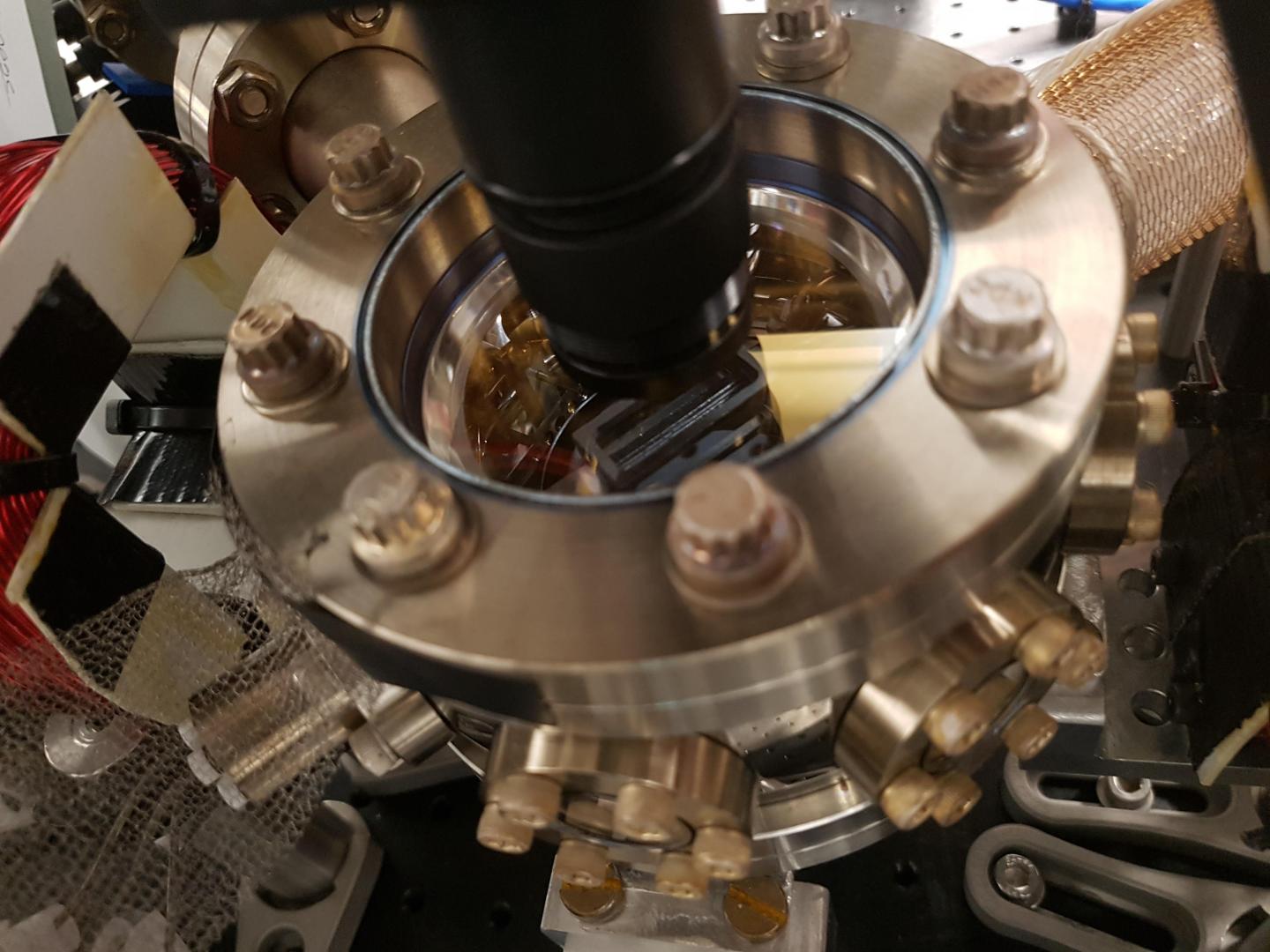 An ion trap in Professor Michael J. Biercuk's laboratory in the Sydney Nanoscience Hub. Source: University of Sydney
Industrial sensors are everywhere in technology. In order to function successfully, these sensors must be able to identify tiny signals from a cluttered background.
For most people it’s easy: you walk into a room filled with people and you can pick out one voice among all the others. Operations like this aren’t so easy for industrial sensors, and they are even harder for quantum devices.
A team led by Professor Micheal J. Biercuk from the University of Sydney, in collaboration with Dartmouth College and Johns Hopkins Applied Physics Laboratory, has developed quantum control techniques that enable a new generation of ultra-sensitive sensors that can identify tiny signals while rejecting background noise to theoretical limits.
"By applying the right quantum controls to a qubit-based sensor, we can adjust its response in a way that guarantees the best possible exclusion of the background clutter – that is, the other voices in the room," said Professor Biercuk, a chief investigator at the ARC Centre of Excellence for Engineered Quantum Systems.
The devices themselves have improved, but the measurement protocols that are used to capture and interpret signals have lagged behind. Because of this, quantum sensors often have fuzzy results, which complicated interpretation of the data through a phenomenon called “spectral leakage.” This is kind of like being distracted by the wrong voices in the room.
The University of Sydney research demonstrates control protocols that help take advantage of improved sensor hardware.
The experiments used trapped atomic ions, and they have reduced spectral leakage by many orders of magnitude over the conventional methods. According to Professor Biercuk, in certain circumstances, these new methods are up to 100 million times better at excluding the background.
Quantum sensors take advantage of the thing that actually makes building quantum computers so difficult. Quantum bits, called qubits, are the building blocks of quantum computers. But qubits are highly prone to losing their quantum properties because of interferences from the environment. The challenge can be turned on its head and can be used to build sensors that are incredibly more responsive to the environment than the classical technologies.
Professor Biercuk believes that the new protocols could have applications in medicine, like imaging inside living cells using nanodiamonds. The protocols could also be used in defense and security systems that use quantum-enhanced magnetometers, devices that measure changes in magnetic fields for target identification and tracking.
"Our approach is relevant to nearly any quantum sensing application and can also be applied to quantum computing as it provides a way help identify sources of hardware error. This is a major advance in how we operate quantum sensors," said Professor Biercuk.
The paper on this research was published in the journal Nature Communications.
