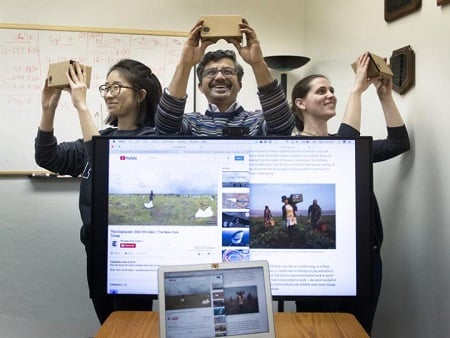
 The project team for research on VR in journalism. At center is Prof. S. Shyam Sundar. Image credit: Patrick Mansell
A team of researchers at Penn State has some advice for journalists: Use virtual reality sparingly. While the technology may help pull readers into a story, it can also diminish credibility if utilized in a way that is too “flashy.”
As reported in the journal Cyberpsychology, Behavior and Social Networking, a study in which 129 participants experienced two magazine stories in one of three different modalities – reading them in print, watching 360-degree videos or viewing them with a cardboard VR viewer – showed that VR stories significantly outperformed text-based articles in several categories. According to S. Shyam Sundar, a communications professor and co-director of Penn State’s Media Effects Research Laboratory, participants indicated that VR gave them a “sense of presence” and increased their empathy for the story’s characters.
"Virtual reality is often called an empathy machine,” Sundar said. “We did find that participants in both the VR and 360-degree video conditions were more empathetic toward the story characters than their counterparts in the text condition, and they also reported higher intention to share the story with others.
But the researchers cautioned that a reliance on flashy VR elements could cause the audience to have less trust in the story.
"What really makes people trust VR more is that it creates a greater sense of realism compared to text and that creates the trustworthiness," said Sundar. "If it doesn't give that sense of realism, it can affect credibility.” Sundar noted that “gamifying” the story or making it more fantasy-like may make people wonder about the credibility of what they are seeing.
The researchers also found that VR and 360-video demand more attention, which can hurt reader recall of story details – although Sundar says that more research is needed to fully understand this effect.
Sundar added that the using a cardboard VR viewer to experience 360-degree videos was superior to interacting with the same videos on a computer screen.
