Nanotechnology is important in removing toxic chemicals found in soil. Currently, more than 70 Environmental Protection Agency (EPA) Superfund sites are using or testing nanoparticles to remove or degrade environmental contaminants. Nano-zero-valent iron is currently being widely used, although its effect on organisms has not been studied yet.
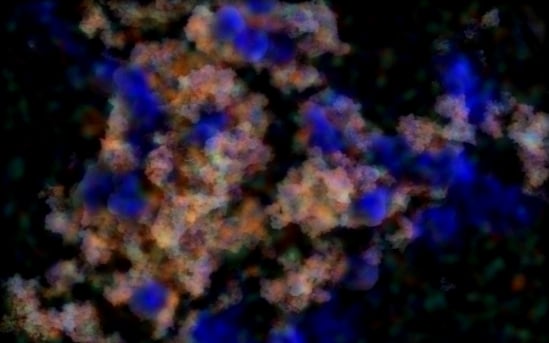 Cadmium (green) was mostly adsorbed by FeSSi (orange) and not algae (blue). Source: Sage Davis
In a recent experiment, a team of scientists from UC Santa Barbara tested the effect of sulfurized nano-zero-valent iron (FeSSI) on common freshwater alga (Chlamydomonas reinhardtii). They found that FeSSi picked up cadmium from a water medium and alleviated cadmium toxicity to that alga for more than a month.
"However, when FeSSi was doing what it was designed to do, we found it was up to 10 times more toxic when bound to cadmium than without," said lead author Louise Stevenson, a postdoctoral scholar in UCSB's Department of Ecology, Evolution and Marine Biology (EEMB). "The current standards for what is an acceptable concentration to use are based on data from the particle itself unbound to the contaminant. Our work suggests that those allowable limits potentially could be huge underestimations of the actual toxicity."
To simulate a precipitation event in which toxic material from soil washes into a waterway, the researchers dosed C. reinhardtii with the cadmium-laced FeSSi. They then waited an hour before they started to take measurements. They found the organic material in the algae produced as a byproduct of photosynthesis mitigated the toxicity of FeSSi and allowed the nanoparticle to remediate up to four times as much cadmium.
"The organic material makes the FeSSi particle less toxic, which allows a greater zone of remediation and increases the cadmium concentrations that can be used," Stevenson said. "That's interesting because every natural system contains some organic material. Along with the toxic effect of the nanoparticles just on cell viability, we identified an important feedback between organic materials produced by the algae itself decreasing toxicity, which decreases toxicity to the algae.”
According to Stevenson, the environmental effects of technology are very context specific. This makes overarching predictions difficult. The UCSB team designed a dynamic ecological model that can be used to extrapolate what they tested. The investigators amassed enough data to develop a series of equations to describe the dynamic of the concentrations they tested.
"We're developing new technology faster than we can predict its environmental impact," Stevenson noted. "That makes it very important to design experiments that are ecologically and environmentally relevant but also get at dynamics that can be extrapolated to other systems."
A paper on this research was published in ACS Nano.
