
 Source: Fraunhofer FEP
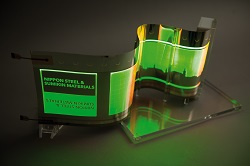
Used for everything from cutlery to construction, stainless steel can now serve as a substrate for flexible electronic components. Fraunhofer Institute for Organic Electronics, Electron Beam and Plasma Technology FEP, Germany, is working with the Nippon Steel & Sumikin Materials Co., Ltd. (NSMAT) and Nippon Steel & Sumitomo Metal Corporation (NSSMC) to develop technology for applying organic light-emitting diodes (OLEDs) to stainless steel foil.
Homogenous large-area lighting surfaces with current densities of more than 10 milliamps per square centimeter are feasible, due to the good thermal conductivity of stainless steel and the use of a planarization layer developed by NSSMC. Stainless steel can also shield OLEDs from the damaging impacts of water vapor and oxygen.
The researchers envision near-term use of OLEDs on stainless steel in automobiles as turn indicator and back-up lights, as cladding for fascia and as advertising displays.
To advance this technology, Fraunhofer FEP will continue to develop roll-to-roll processing lines for manufacturing OLEDs on flexible materials and an OLED process with high reproducibility.
