
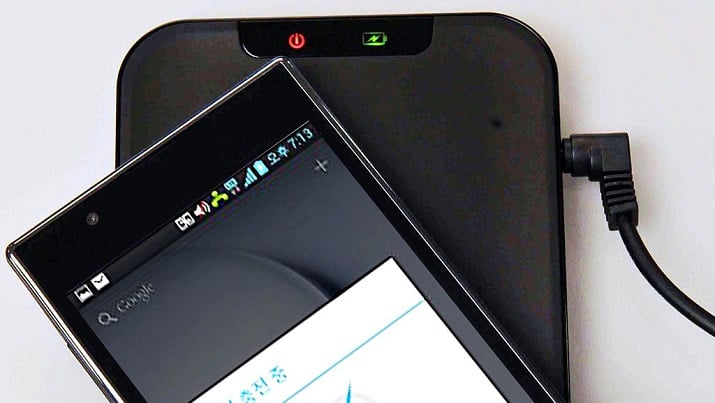
 A wireless cell phone charger. Source: LG Electronics, CC BY 2.0
Wireless power has the potential to “free us from the power cord,” according to electrical and computer engineering professor David Ricketts, senior author of a paper on the work published in IEEE Antennas and Wireless Propagation Letters. A familiar example is seen in wireless cell phone charging pads—but their utility is limited by the need for close proximity of the device to the pad.
“Recent work by several researchers have extended wireless power to 'mid-range' which can supply power at inches to feet of separation,” notes Ricketts. “While encouraging, most of the wireless power systems have only focused on the power problem – not the data that needs to accompany any of our smart devices today. Addressing those data needs is what sets our work apart here."
It’s sort of a catch-22: Transmitting wireless power relies on magnetic fields; to minimize the power lost by generating those fields, narrow bandwidth antennas are used. But narrow bandwidth limits data transfer, which is why devices generally use separate radios for data—which, in turn, increases the cost, weight and complexity of the device.
The NC State team theorized that a wide-bandwidth system could be configured with narrow-bandwidth components, providing what Ricketts calls “the best of both worlds.”
Testing their system with and without data transfer, the researchers found that a 3-watt power transfer resulted in the loss of only 2.3 percent efficiency when data was also transmitted, at a rate of 3.39 megabytes per second. Those 3 watts are more than enough to power a tablet during video playback. In addition, the tests were conducted with the transmitter and receiver at a distance of 16 centimeters (6.3 inches) apart.
“Our system… shows that you can design a wireless power link system that retains almost all of its efficiency while streaming a movie on Netflix," Ricketts said.
