
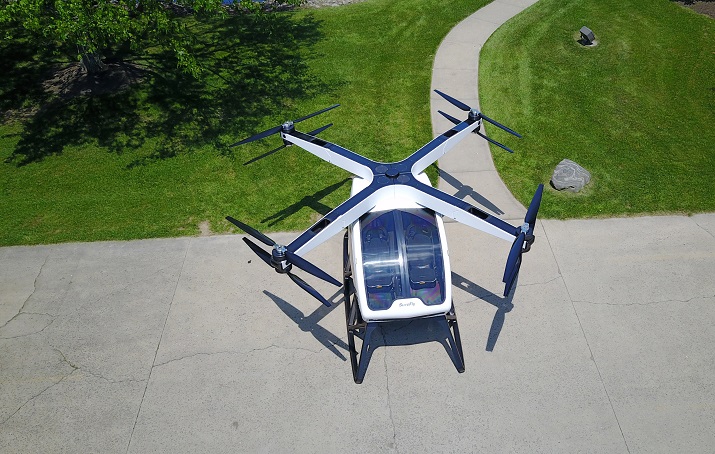
 The SureFly hybrid/electric personal helicopter. (Credit: Workhorse Group Inc.)
It’s a personal helicopter. And if you happen to be Oshkosh, Wisconsin at the end of July, you can see it on display – for the first time in the country.
Called the SureFly, it’s a concept created by Workhorse Group Inc., a technology company focused on providing electric mobility solutions to the transportation sector. The company says that the goal of SureFly is to be safer and more stable than a typical helicopter, due to its redundant design – four propeller arms with two fixed, contra-rotating props apiece, each operating independently. Those propeller arms fold down to minimize the footprint, allowing it to fit inside a standard garage. There’s also a gas combustion engine to generate electricity and a parallel battery pack offering a redundant/backup power source, so long battery charges between flights are eliminated. In the event of an engine failure, there’s even a ballistic parachute to bring the craft down safely.
The design leverages platform battery packaging, management systems and controls already in use in Workhorse’s commercialized medium-duty, extended-range-battery electric vehicles. Designed for short hops with a range of approximately 70 miles, the aircraft is currently undergoing ground testing; the company expects to have FAA certification by 2019.
The SureFly is a two-seater that's designed to be easy to pilot, although this may be a moot point -- future models will be designed for autonomous flight, capable of carrying payloads up to 400 pounds. Anticipated markets are precision agriculture, emergency responders, city commuters and the military.
More specs:
- Piloted vehicle designed to carry pilot and passenger, or pilot and cargo
- Electric-driven props: 2 contra-rotating props per arm; eight motors, each driving a single propeller
- Fix prop pitch and no transitional parts (wings, tail, tilt rotor, tilt wings) for simplicity and safety
- Gasoline piston engine drives dual generators to provide power to prop motors
- Dual lithium battery packs: 7.5kWh each, used for emergency landing power (5 minutes) in the event the gasoline generator fails
- Fuselage and props are carbon fiber for durability and light weight
- Curb weight: 1100 lbs.
- Max takeoff weight: 1500 lbs.
- Top speed: 70 mph
- Flight ceiling: 4000 feet
- One hour of flight time available per tank of gasoline
Estimated cost is under $200,000, and the company is already accepting pre-orders.
