
A "near-zero-power" temperature sensor developed at the University of California San Diego could extend the battery life of wearable or implantable devices that monitor body temperature, smart home monitoring systems, Internet of Things devices and environmental monitoring systems.
What exactly is meant by “near-zero-power”? The sensor runs on only 113 picowatts of power — 628 times lower power than state-of-the-art and about 10 billion times smaller than a watt.
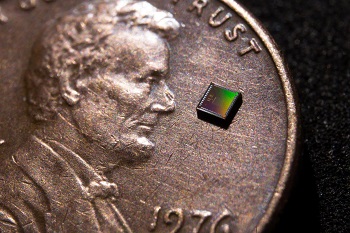 The temperature sensor is integrated into a small chip measuring 0.15 × 0.15 square millimeters in area. (Source: University of California San Diego)The technology could also enable a new class of devices that can be powered by harvesting energy from low-power sources, such as the body or the surrounding environment.
Engineers sought to minimize power in two domains — the current source and the conversion of temperature to a digital readout.
An ultra-low power current source was built using “gate leakage” transistors — transistors in which tiny levels of current leak through the electronic barrier, or the gate. Transistors typically have a gate that can turn the flow of electrons on and off. But as the size of modern transistors continues to shrink, the gate material becomes so thin that it can no longer block electrons from leaking through — a phenomenon known as the quantum tunneling effect.
While gate leakage is considered problematic in systems such as microprocessors or precision analog circuits, the researchers using these minuscule levels of electron flow to power the circuit.
By use of these current sources, researchers developed a less power-hungry way to digitize temperature. This process normally requires passing current through a resistor, measuring the resulting voltage, and then converting that voltage to its corresponding temperature using a high-power analog to digital converter.
Instead of this conventional process, researchers developed an innovative system to digitize temperature directly and save power. Their system consists of two ultra-low power current sources — one that charges a capacitor in a fixed amount of time regardless of temperature, and one that charges at a rate that varies with temperature, slower at lower temperatures and faster at higher temperatures.
As the temperature changes, the system adapts so that the temperature-dependent current source charges in the same amount of time as the fixed current source. A built-in digital feedback loop equalizes the charging times by reconnecting the temperature-dependent current source to a capacitor of a different size — the size of this capacitor is directly proportional to the actual temperature. For example, when the temperature falls, the temperature-dependent current source will charge slower, and the feedback loop compensates by switching to a smaller capacitor, which dictates a particular digital readout.
The sensor is integrated into a small chip measuring 0.15 × 0.15 square millimeters in area and operates at temperatures ranging from minus 20 C to 40 C. Its performance is fairly comparable to that of the state of the art even at near-zero-power, but one tradeoff is that the sensor has a response time of approximately one temperature update per second, which is slightly slower than existing temperature sensors. However, this response time is sufficient for devices that operate in the human body, homes and other environments where temperatures do not fluctuate rapidly.
