
A color sensor for display-equipped devices such as smartphones and tablets capable of detecting the color temperature, brightness and RGB (red-green-blue) components of ambient light is now available from ROHM Semiconductor (Kyoto, Japan and Santa Clara, Calif.). A working demo will be showcased at booth 616 at this year’s Sensors Expo held June 28-29 at the McEnery Convention Center in downtown San Jose, Calif.
The BH1747NUC leverages original infrared removal technology and computing methods to achieve the industry's highest infrared cutoff characteristics, reducing the effects of infrared rays tenfold compared with conventional products. This enables compatibility with dark (low permeability) optical windows, unlike conventional color sensors that cannot provide accurate detection due to the effects of infrared interference when dark windows are used.
Recently, manufacturers of smartphones, tablets and other display-equipped devices have begun to integrate color sensors in order to analyze the RGB components of ambient light for display image adjustment or perform backlight dimming based on the surrounding brightness levels.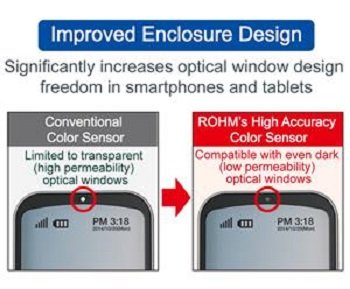 (Source: ROHM Semiconductor)
Conventional color sensors require a transparent optical window in order to accurately detect visible (i.e. RGB) light. However, the design trend in many smartphones and portable devices is to adopt dark optical windows, which are more stylish but make it difficult to precisely detect colors, since less visible light gets through and the light that does permeate gets mixed in with IR rays.
In response, ROHM has applied its optical sensor expertise, including original infrared removal technology and proprietary computing methods, to develop a color sensor that provides improved performance and high sensitivity (4 times higher than even ROHM’s BH1745NUC) – to support even darker optical windows (down to 1% transmissivity).
