
For the first time in aviation history, an unmanned aircraft has successfully tested a cloud-seeding payload during an experimental flight in Nevada.
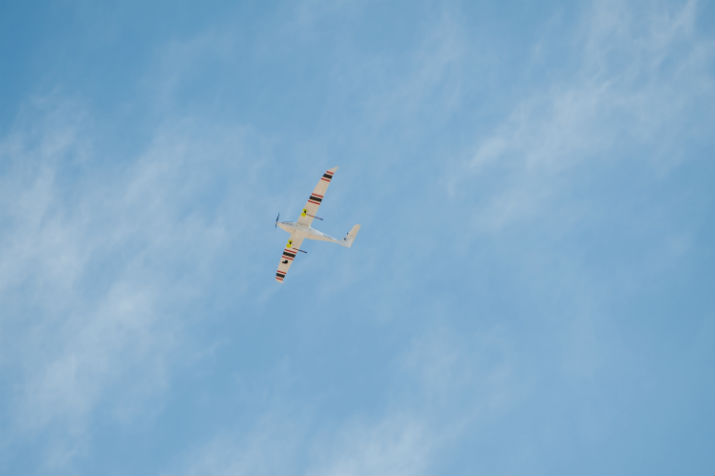 The Savant™ flies with cloud-seeding flares. (Image Credit: Kevin Clifford, Drone America)
The Drone America Savant™ aircraft was flown at Hawthorne Industrial Airport, reached an altitude of 400 feet and flew for approximately 18 minutes, during which time it deployed two silver-iodide flares, proving its ability to perform unmanned aerial cloud-seeding operations.
"This is a tremendous accomplishment for the state of Nevada and everyone involved," said Adam Watts, the project's lead scientist.
The operation was led by the Desert Research Institute (DRI) to help the state of Nevada address the impacts of drought and explore solutions for natural-resource challenges, such as augmenting regional water supplies.
Using drones in this effort could potentially reduce both the risks and costs of the cloud-seeding industry.
"With a wingspan of 11 feet, 10 inches and its lightweight design (less than 55 pounds), the Savant™ is the perfect vehicle to conduct this type of operation due to its superior flight profile, long flight times and its resistance to wind and adverse weather conditions,” said Mike Richards, President and CEO of Drone America.
 Preparing to test fly the Savant™ sUAS with cloud seeding flares. (Image Credit: Kevin Clifford, Drone America)
Las Vegas-based unmanned aerial data services company AviSight performed aerial support for the test flight with its manned aircraft. The company recorded both infrared and HD video of the flight to support future system refinements and plans to conduct UAS flights beyond visual line-of-sight.
"This is an important step for Nevada and the unmanned aerial industry," said James Fleitz, co-founder of AviSight. "This collaborative effort highlights the diverse applications of unmanned systems and showcased the ability of this technology to support scientific advancements."
The DRI researchers, along with assistance from Drone America and AviSight, now plan to create weather forecasts and conduct flight planning for manned and unmanned aircraft, as well as conduct additional tests of cloud-seeding operations using manned and unmanned systems.
According to Amber Broch, chief engineer for the project and an assistant research engineer at DRI, this first-ever operation displays the potential of unmanned systems as tools for environmental science.
