
A dual-jaw robotic gripper with pinchers capable of grasping a chicken carcass by the legs, lifting and hanging it on a shackle conveyor to be moved on for additional processing has been developed by a team from the Arkansas Agricultural Experiment Station
Originally developed in response to labor shortages in poultry processing plants amid the COVID-19 pandemic, the ChicGrasp is now a robotics system capable of learning by imitating human movements to handle chickens using an imitation learning algorithm and camera perceptions.
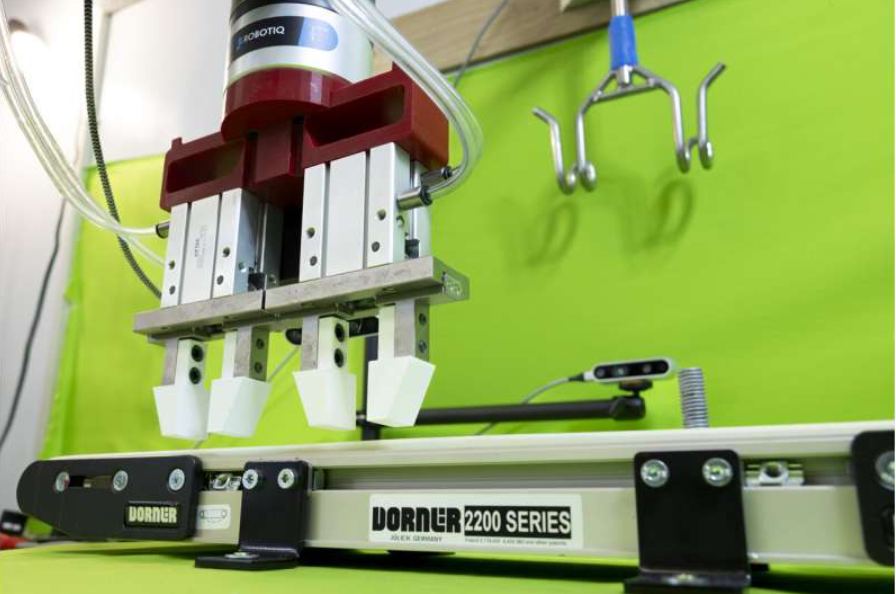 Source: UADA/Paden Johnson
"Embodied AI is used to create intelligent, agent-like robotics to interact with a real-world environment," the researchers explained. "It's a physical art that has just developed in the past couple of years, which you see in things like full self-driving cars. We are trying to do similar things using that imitation learning idea, but in chicken processing."
The developers of the ChicGrasp explained that traditional robotic methods — like using suction cups or pre-programmed scripted motions — tend to struggle in the uncertain poultry processing line setting. Specifically, the birds are cold, slippery and can present in different sizes and postures. Subtle changes in leg position or carcass orientation can result in robotics failing. As such, the team developed a system that learns from human teachers instead of treating the gripper and control algorithm separately.
Imitation learning lets humans offer example trajectories so that robots do not have to learn tasks from scratch, thereby improving efficiency and accuracy. Camera inputs and movement data are stored as low-dimensional data to control the robotic arm’s joints. Using a diffusion policy algorithm, the system consistently refines grasping strategies by treating robot control as a conditional denoising process.
Under the same conditions, other robotics learning methods failed, the team explained.
"That's why we're getting inspired by this algorithm for the poultry industry. Years ago, robots were programmed specifically to this specific coordinate at this specific time. But what if, like in the poultry industry, things are not predictable? You cannot engineer the robot to go exactly in this position. The chickens come in various sizes, and chicken legs are not always in the same position. So that's why we wanted the robot to be able to adjust based on that specific scenario."
For now, ChicGrasp has demonstrated a roughly 81% success rate, but the team cautioned that speed is still an impediment for industrial use. Notably, a human worker can pick up a chicken carcass and hang it on the shackle conveyor in approximately three seconds while the full cycle for ChicGrasp is approximately 38 seconds.
The robotic system is detailed in the article, “ChicGrasp: Imitation‐Learning‐Based Customized Dual‐Jaw Gripper Control for Manipulation of Delicate, Irregular Bio‐Products,” which appears in the journal Advanced Robotics Research.
