
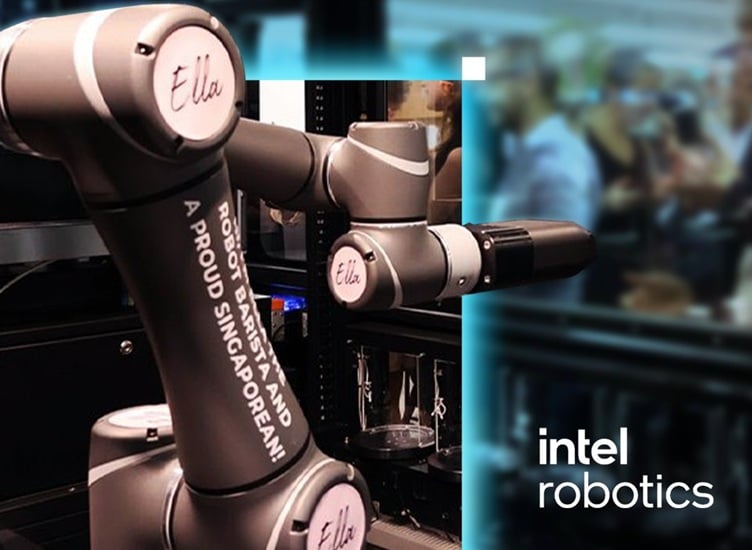
At the main entrance of Taipei’s Nangang Exhibition Center this week, a robot barista named Ella is making coffee. The interesting thing is that under the hood, Intel Series 3 processor is powering what is billed as the first multi-agent physical AI store.
Three specialized AI agents handle customer conversation, system operations and store-level intelligence, all on a single Intel system-on-chip (SoC). This is without a fragmented stack or discrete accelerator.
This isn’t just a one-off robot either. At Computex 2026, Intel announced 130 design engagements for its Series 3 processor family, signaling a broader industry bet on AI and robotics.
To enable the robotics sector to turn development designs into deployed fleets, Intel also introduced OpenVINO physical AI, an open-source framework to address cost and scale deployment challenges.
“Physical AI models are transforming robotics, but deployment has been slowed by fragmented software stacks and one‑off integrations for every robot,” said Dan Rodriguez, corporate VP of the Edge Computing Group at Intel.
Intel Core Ultra Series 3 and OpenVINO Physical AI allow users an easier path from experimentation to production-grade robotics with high-performance inference, Rodriguez said.
Ella’s three AI agents running concurrently on a single SoC creates a new path to scale robot designs that can handle:
- Customer conversations
- System operations
- Store-level business intelligence
Running OpenVINO physical AI provides developers with a way to take robot policies and multimodal models from the experiment phase through a working robot system with maximum inference performance. The open source robotics models can also integrate Physical AI Studio and LeRobot for more model exports.
