
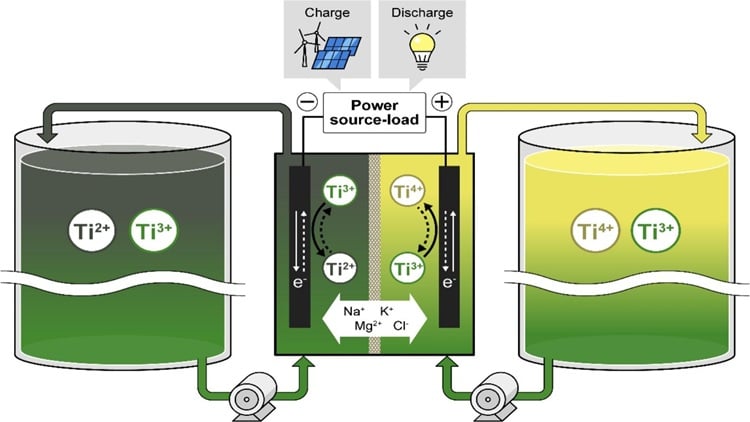
Redox flow batteries have emerged as an important technology for large‐scale energy storage. These systems are primarily based on vanadium, an element in limited supply, and are characterized by limited charge-discharge current densities. An alternative component that eliminates supply issues and enhances battery performance is titanium.
Recognizing these benefits, researchers from Tohoku University (Japan), University of Science and Technology Beijing (China), Lanzhou University of Technology (China) and Beijing University of Technology (China) have developed a redox-flow battery that uses titanium ions as the redox-active material and molten salt as electrolyte. The device is engineered to provide higher charge-discharge current density for grid-scale energy storage applications compared to conventional vanadium redox flow battery designs.
As reported in Electrochemistry Communications, different titanium redox couples are used at the cathode and anode, enabling reversible redox reactions. Lithium chloride-potassium chloride (and other molten salt electrolytes) also provide a wide electrochemical stability window and high ionic conductivity, while supporting efficient and high-voltage operation, rapid charge-discharge rates and stable cycling at temperatures between 300° C and 450° C. A porous aluminum oxide crucible serves as a separator, along with carbon and graphite electrodes connected by nickel leads.
Tests demonstrated a high t-cell voltage of about 1.55 V, a high coulombic efficiency of over 97% and stable cycling even at high charge-discharge rates. The molten salt composition can be tuned to optimize cost, temperature range and electrochemical performance.
