
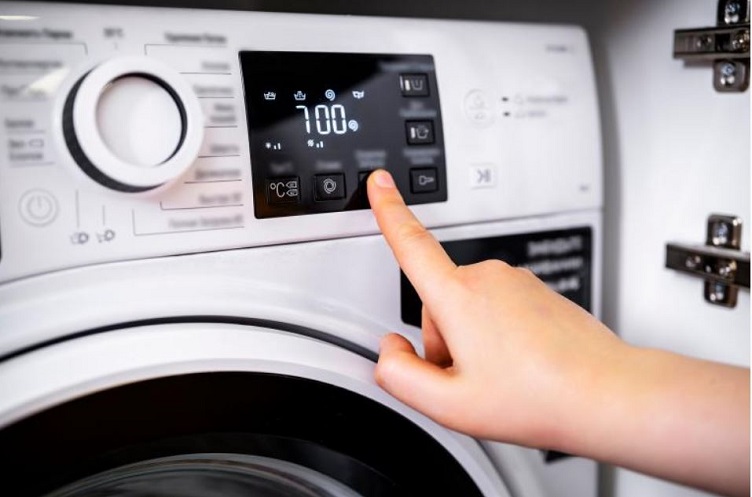
The use of sensors in household appliances is nothing new. The humble washing machine, for example, has numerous sensors that detect load weight, water level, temperature, door lock switches, motor speed, imbalances and even dirt. Sensors are also embedded in virtually every smart application, which is one of the reasons that the number of sensors has soared in recent years, with more than 7,2 billion smart sensor units deployed worldwide in 2024.
Sensors are also playing an increasing role in improving energy efficiency, enabling the appliances themselves to adjust power output to real-time needs, as well as to consume a lot less power when not in active use. They are becoming an essential tool in the fight to lower our energy use and, in fine, reduce global emissions.
An example is televisions. Many sets today have sensors that automatically detect how much ambient light is in a room and adjust the screen’s brightness to suit. The darker the room, the dimmer the screen - using less electricity as a result. “Many TVs can also detect how much motion there is in a picture and dynamically dim parts of the screen based on what is being displayed,” says Dave Wilson, an international expert and co-convenor of the IEC technical committee for the environmental and energy aspects for multimedia systems and equipment, IEC TC 100/TA 19.
Another example, he says, is computers. Sensors can detect when someone is using the computer and switch it to “sleep” or energy-saving mode when not being used.
Sensors are becoming intelligent
Peter Anderson, an expert within the IEC technical committee for automatic controls, IEC TC 72, says that while sensors have been around for decades, what is changing is their ability not just to detect problems, but make diagnostic assessments and then decisions based on preset algorithms.
“Adding complex signal conditioners and compensation around the sensing element has enabled better accuracy and long-term performance. It has also allowed sensor technology to be deployed in areas previously not applicable due to electronics (and potentially other sensors) being able to cancel unwanted influences. It's this additional hardware and software surrounding the sensing element that blurs the line between sensor and control as the sensor becomes more "intelligent" and able to perform self-diagnostics and adjust to external influences.”
Erika Cruz, an electrical engineer at a multinational manufacturer of household appliances, agrees: “Sensors are definitely getting smaller, but what is new and being explored is the use of sensors with AI to optimize the performance and resource use of an appliance. This means ensuring the exact amount of water or power or soap is used, or that a cooking appliance cooks at the optimal temperature.”
The challenge, she says, is making sure they work as effectively in the real-world environment as they do in the lab. “It is also about ensuring sensors are durable under real-world conditions at a cost that is acceptable for the consumer.”
Ensuring sensors don’t malfunction is another challenge. If sensors are incorporated into safety controls in an air conditioning system, for example, and they malfunction, they could fail to detect problems such as harmful levels of gases and thus prevent the activation of safety-related alarm systems.
Sensor deviation and drift
Anderson explains that two of the main issues incorporating sensors into safety controls are deviation and drift, as well as failure modes of the sensor. (For more on deviation and drift, read this e-tech article).
“Deviation and drift are essentially measures of the accuracy of the sensor over manufacturing tolerances, lifetime and other conditions such as temperature, humidity or electromagnetic compatibility."
"A safety control mechanism must be certain the information it's basing its decisions on are accurate. Designers of these types of controls must understand the long-term capabilities of the sensors and ensure the deviation and drift are within acceptable tolerances. If not, they need to add additional mitigations to detect the variation and either compensate for it or enter a safe state, which in our world, means generally ceasing operation," she adds.
Standards ensuring sensor redundancy
The IEC 60730 series of standards addresses functional safety, including the impact of sensors on controls. IEC TC 72 recently published IEC 60730-2-23 to address the growing incorporation of sensors used in automatic safety controls.
A sealed water heating tank, for example, may rely on a temperature sensor to regulate temperature. But if that temperature sensor were to give erroneous data, the tank could overheat, over-pressurize and rupture, in addition to using unnecessary power. IEC 60730-2-23 ensures the control has provisions to either ensure sensor reliability or has sufficient redundancy so that, if one sensor fails, a secondary sensory provides the necessary data.
“One goal of this standard is to help designers more easily incorporate sensors into their control designs by evaluating the sensor by itself”, says Anderson. "IEC 60730-2-23 subjects the sensor to tests and requirements relevant to the underlying sensor technology, resulting in a comprehensive evaluation that can aid a control designer and the test house,” she adds.
Measurement is key for energy efficiency
Sensors that help to reduce energy consumption are an important part of the energy efficiency equation. Trusted ways of accurately measuring power consumption are key, as they help policy makers increase pressure on manufacturers to make their products use less energy. This can also fuel innovation, as manufacturers look for ways to improve functionality while reducing energy use, says Dr Lloyd Harrington, convenor of the maintenance team (MT) within IEC TC 59, responsible for developing standards for the measurement of standby power in household appliances, IEC TC 59/MT 9.
“What is changing is the increased focus on measuring power consumption in an appliance’s various modes of use, not just when it is being used actively. This can be challenging to measure, but it helps to raise awareness amongst manufacturers to consider its true overall power consumption, both when it is used and when it is not.”
He gives the example of the robot vacuum cleaner. “When it is not in use, it may consume a small amount of power just sitting there, but after 12 hours it might do a quick recharge of the battery. You need to understand this behavior if you want to measure it accurately.”
The sensors themselves also need to be taken into account, he adds. “If sensor systems are implemented efficiently, they will use only a small amount of power (and potentially save a lot of energy), but if not, they could use a significant amount of power.”
Standards for energy efficiency
The IEC has a number of standards for measuring the power consumption of appliances, such as IEC 62301, which measures the power used when on standby, and IEC 63474, which measures the power required for products to be activated via a network.
Having greater transparency around power use, coupled with government incentives or policies, can make a huge difference to the products manufactured. And it already has.
“Take TV remote controls,” says Harrington. “In the 1970s, most used around 15-25 watts in standby mode. Today, many products can use 0,1 watt for the same functionality.”
The importance of certification
Third-party testing and certification are also a solid way of demonstrating compliance to policy makers and validating the results. Third-party conformity assessment, such as the IECEE Certification Body scheme for the safety and performance of appliances, as well as its energy efficiency program, are also essential to both address the problem, demonstrate compliance and build trust in the market.
Other useful standards include IEC 62552-3, which provides methods for determining energy consumption of fridges under different usage and climate conditions, the IEC 62087 series for measuring power consumption of audio and video, and IEC 62233, which defines ways of measuring electromagnetic fields from household appliances.
These are just a few examples. With the increased use of AI in sensor technology, household appliances are becoming smarter and more efficient, and standards and conformity assessment are evolving with them to ensure they remain safe.
