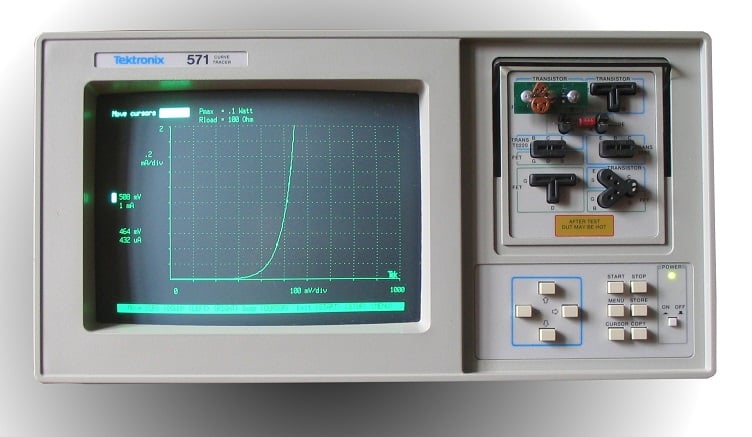
AI-enabled oscilloscopes are advanced test instruments that combine traditional oscilloscope hardware with artificial intelligence (AI) and machine learning software. In a standard oscilloscope, engineers view voltage or current waveforms over time and manually interpret the signals.
By contrast, an AI-enabled oscilloscope doesn’t just display a waveform — it automatically interprets the signal to find meaningful patterns, anomalies and insights.
Think of it this way: A regular oscilloscope shows you the raw electrical signal, whereas an AI-enabled scope can analyze that signal in real-time to recognize patterns, detect anomalies, predict potential failures and even suggest optimizations beyond what a human might quickly see.
In essence, these instruments leverage AI algorithms to act as an intelligent assistant alongside the engineer, turning the oscilloscope from a passive display device into an active diagnostic tool.
Engineers across industries are beginning to apply AI-enabled oscilloscopes in a variety of applications. The following are some examples of where these oscilloscopes may play.
High-speed digital design
In domains like computer buses, memory interfaces or high-speed serial links, signal integrity is critical. AI-enhanced oscilloscopes help analyze eye diagrams and jitter measurements to pinpoint the root cause of signal integrity issues much faster than a human could.
For instance, if a particular bit error or timing glitch occurs sporadically, the AI can detect the pattern of conditions leading to it (such as a specific data pattern or a simultaneous switching event causing noise). This allows digital designers to rapidly identify and fix issues in DDR memory, PCI Express or SerDes links, accelerating the design validation of high-speed boards and chips.
RF and wireless communications
Radio frequency signals are complex and often subject to interference or unexpected anomalies. AI-enabled scopes (often combined with spectrum analysis features) can scan spectrum or modulation waveforms and identify interference signals or abnormal modulation patterns automatically.
For example, in a wireless IoT device test, the oscilloscope might flag an intermittent spur in the frequency domain that indicates an interfering source. AI can also assist in optimizing modulation schemes by learning which adjustments yield cleaner signals. This is invaluable in telecom, radar and wireless product development, where quick diagnosis of RF issues keeps projects on schedule.
Automotive and aerospace systems
These industries often deal with a mix of analog sensor signals, digital communications (CAN, LIN, ARINC buses) and power electronics — all of which can produce intermittent faults that are hard to catch. AI-enabled oscilloscopes are used to monitor such systems for anomaly detection over long test drives or flight simulations.
For instance, during an automotive electronics test, an AI scope could automatically detect an unusual spike in a sensor voltage that only occurs under specific temperature and speed conditions.
By catching these rare events, engineers can improve reliability and safety. Similarly, in aerospace, where testing is expensive, having the scope’s AI continuously watch for out-of-tolerance signals ensures no critical event goes unnoticed.
Manufacturing test and quality control
In production testing, large numbers of devices must be verified quickly. AI oscilloscopes can learn the “signature” of a good unit’s waveforms and then automatically screen units for any deviation. This is used in end-of-line testing of electronics — the scope might perform a fast, automated pass/fail analysis on analog waveforms or digital signal timing.
If any device shows an anomaly (even one that isn’t explicitly in a test specification), the AI can alert the engineers. This reduces human error in quality control and catches subtle defects, improving overall product quality.
Moreover, by automating waveform analysis in manufacturing, test engineers can throughput more units in less time, since the scope is effectively doing the analysis on the fly rather than requiring slow manual inspection.
Research and development data analysis
In scientific research (such as physics experiments, high-energy experiments or biomedical signal analysis), oscilloscopes might capture extremely large data sets to find rare events. AI-enabled oscilloscopes or their companion software can significantly accelerate these workflows.
For example, in a particle physics lab, instead of manually searching through oscilloscopic data for an event of interest, the AI can be trained to recognize the event’s signature and scan through hours of data in moments to find occurrences.
Engineers and scientists can then spend their time interpreting results rather than wrangling data, effectively speeding up the experiment cycles. This use case highlights how AI oscilloscopes not only serve traditional engineering but also cross into big-data analysis in science.
Conclusion
AI-enabled oscilloscopes illustrate how adding intelligence to our measurement tools can elevate productivity and innovation. By automating waveform analysis, reducing human error and accelerating the design validation process, these smart instruments allow engineers to focus on creativity and problem-solving rather than rote data processing.
The infusion of AI into oscilloscopes is a prime example of technology augmenting human capabilities — the engineer and the intelligent instrument working together to achieve insights faster and design better, more robust electronics.
