
Taking inspiration from the compound eyes of the fruit fly — which are wide-angle and can process visual information much faster than the human eye — researchers at the Chinese Academy of Sciences have built an insect-scale compound eye capable of both seeing and smelling.
Unlike traditional cameras on robots and drones that struggle with a narrow field of view and limited peripheral vision, the insect-inspired compound eye has been designed to possibly improve how drones and robots navigate complex environments and avoid obstacles.
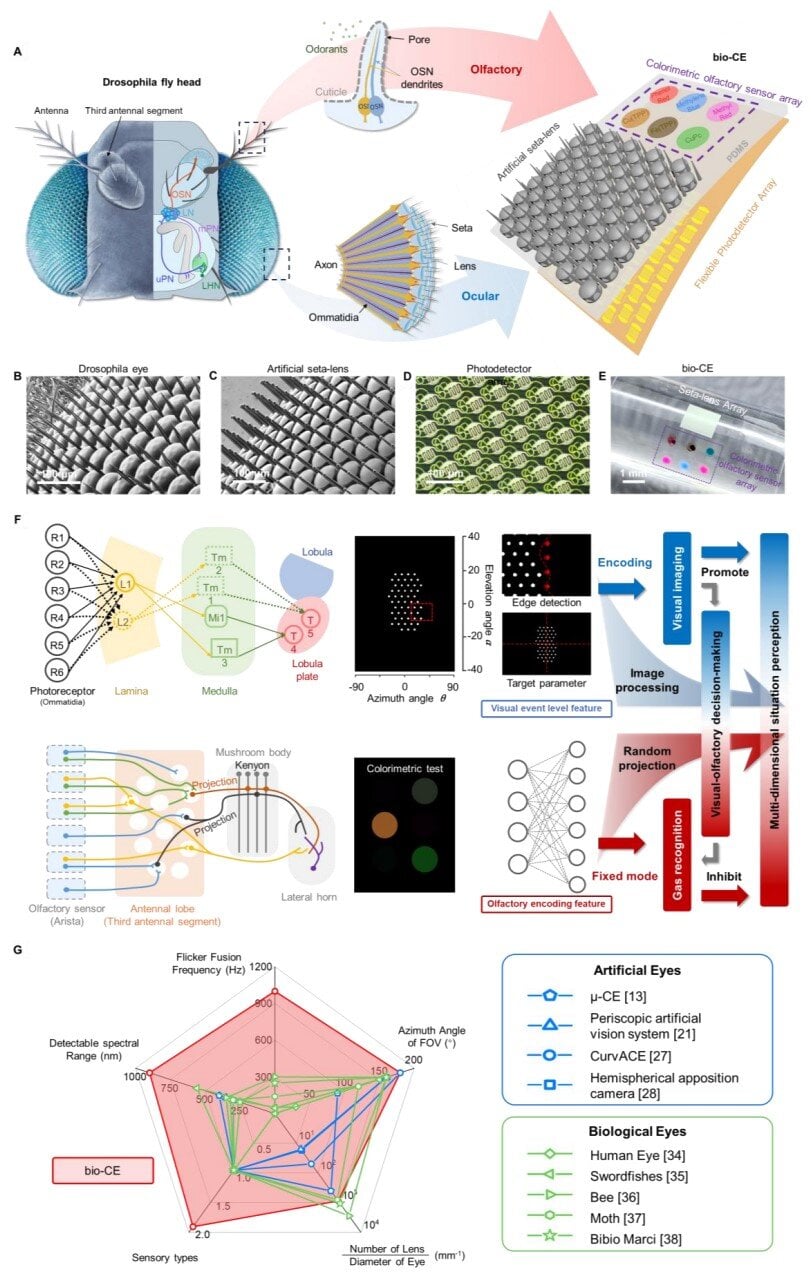 Source: Nature Communications (2026). DOI: 10.1038/s41467-026-68940-0
To develop the artificial eye, the team printed lenses onto flexible sensors through an approach called femtosecond laser two-photon polymerization (FL-TPP).
The insect-scale compound eye structure features 1,027 tiny individual visual units loaded onto an area of roughly 1.5 mm by 1.5 mm. The team also printed setae, which are tiny hairs, between the lenses just as in real fruit flies. The tiny hairs are meant to help keep the lenses clear in humid conditions.
The team also used an inkjet printer to add a color-changing chemical array, which serves as a bionic nose that reacts to hazardous gases in the air, thereby mimicking how a fly uses multiple senses simultaneously.
The final product, dubbed the bio-CE system, was tested by mounting it onto a miniature four-wheeled robot where it demonstrated that it was capable of detecting moving objects and responding to nearby obstacles. The team found that unlike traditional robots, which typically see only what is directly in front of them, this system could simultaneously see obstacles to its left and right without swiveling, thanks to its 180° field of vision. Likewise, the system also sensed hazardous gases.
"The bio-CE system achieves exceptionally high sensitivity for wide-angle moving target detection and proximity avoidance, showing great potential for unmanned platform navigation and bionic robot intelligence," explained the team.
Following some modifications, the system could one day be used in a range of applications such as finding chemical leaks in disaster zones and guiding tiny drones through collapsed buildings to locate survivors.
An article detailing the system, “An insect-scale artificial visual-olfactory bionic compound eye,” appears in the journal Nature Communications.
