
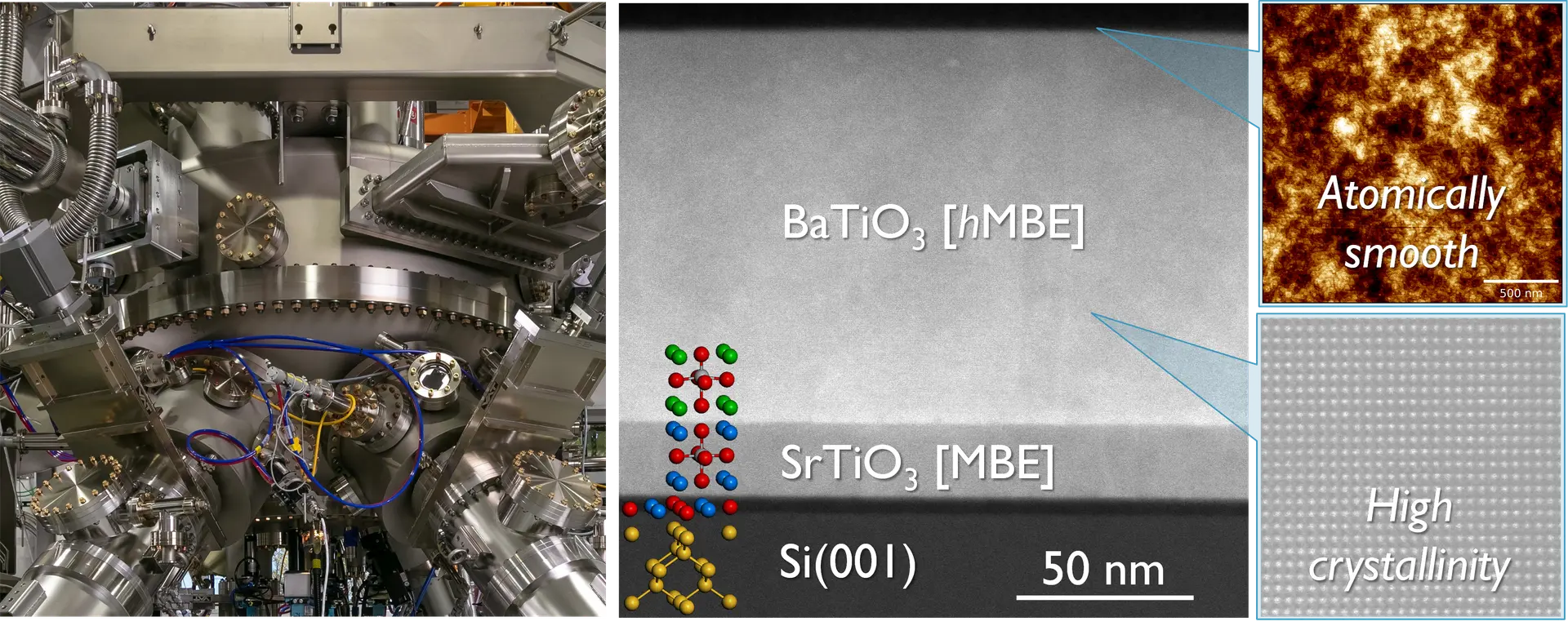
Veeco Instruments Inc. and research hub imec have developed a 300 mm high volume manufacturing process that allows for the integration of barium titanate (BaTiO3 or BTO) on a silicon photonics platform.
BTO holds promise to be used for high-speed and low-power light modulation in emerging applications like:
- High-speed optical transceivers
- Quantum computing
- Light detection
- Lidar
- Augmented and virtual reality
Historically, BTO’s electro-optical properties have been a challenge to convert into high-volume manufacturing. Veeco was able to deliver the first molecular beam epitaxy (MBE) based cluster system.
The 300 mm platform is designed for the epitaxy of BaTiO3 single crystalline thin films on silicon that will be available in both solid and hybrid molecular beam epitaxy (MBE) solutions, the companies said.
Additionally, the system will be capable of BTO-on-silicon deposition with improved repeatability which will lower the costs compared to MBE methods.
Imec cites the optical transceiver market for datacom is expected to grow to $13.1 billion in 2030, up from $2.9 billion in 2024.
Using BTO in silicon will help the trade-offs of current silicon issues of not being powerful enough or consuming too much power in silicon photonics. Currently, there are no commercially available production processes that are compatible with BTO and silicon.
The collaboration is working to scale solutions that allows the integration of materials such as BaTiO3 and SrTiO3 onto a 300 mm silicon platform.
“Over the past 4 years, imec and Veeco have collaborated on developing alternative techniques for BaTiO3-on-Si and benchmarking both material and electro-optic properties towards defining a strategy for advancing large-scale manufacturing solutions,” said Clement Merckling, the scientific director at imec.
