
AI data centers are pushing the limits of copper in terms of both signal integrity and power consumption at high transmission speeds.
The answer is optical interconnects. Because of this, the race to build it out is reshaping the global photonics supply chain in real time.
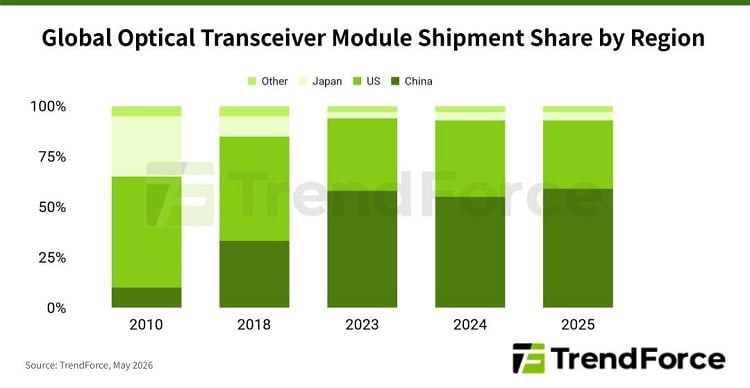
According to market research firm TrendForce, global shipments of optical transceivers will more than triple to 92 million units by 2026, up from 26.5 million units in 2023.
This is tremendous growth, but it is straining existing capacity to a breaking point.
 Source: TrendForce
The bottleneck nobody's talking about
To make matters worse, a bottleneck has emerged in this sector from indium phosphide (InP) laser manufacturing. This is driven by limited qualified capacity and the complex process integration of the equipment.
Without this laser production, optical transceiver buildout will likely stall.
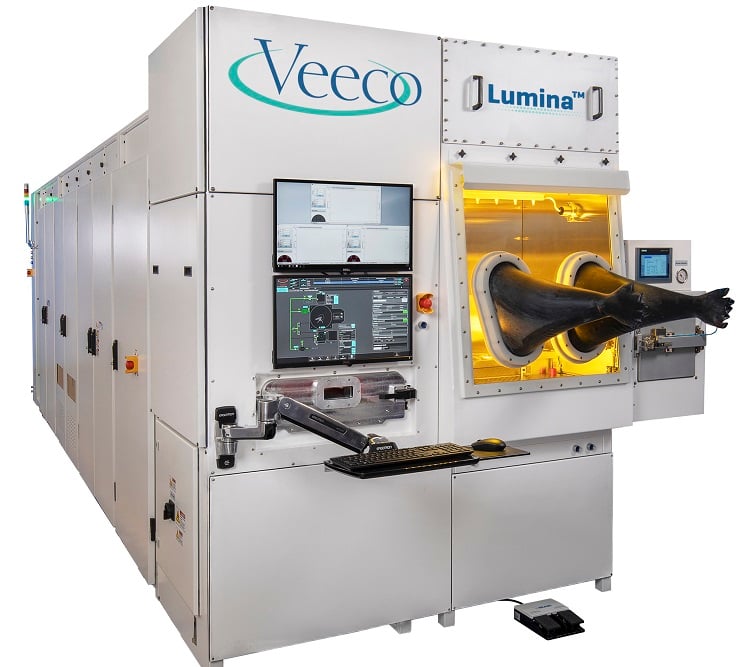
Veeco Instruments called out this urgency with an announcement that it received orders totaling more than $250 million across multiple customers for its Spector Ion Beam Deposition, Lumina MOCVD and WaferEtch Wet Processing systems. Not surprisingly, these instruments are all tied to InP laser manufacturing for silicon photonics.
“These orders reflect the strength of our long-standing customer partnerships, many spanning more than two decades, and our ability to support the evolving requirements of silicon photonics and the optical interconnect market,” said Adrian Devasahayam, senior vice president of Veeco Instruments.
Veeco is starting deliveries in 2026 and ramping up significantly in 2027.
These tools are all important factors in semiconductor manufacturing, specifically:
- The Spector Ion Beam Deposition deposits thin film coatings onto laser facets with precise thickness and reflectivity control.
- The Lumina Metal Organic Chemical Vapor Deposition (MOVCD) grows the epitaxial layers that form the active chip material in InP lasers.
- Veeco’s WaferEtch Wet processing is a chemical etching of wafers during the manufacturing process.
Veeco said the orders came from manufacturers of 800G and 1.6T optical transceivers for hyperscale data centers. Just so happens, this is the same sector TrendForce sees as driving shipment demand.
Rethinking manufacturing
Growing demand for optical transceivers is forcing U.S. vendors in this segment to rethink how they manufacture. TrendForce points to companies Coherent and Lumentum shifting its strategies to accelerate capacity expansion and diversify supply chain risks because of geopolitical pressures.
These companies have previously relied on in-house production but are now looking at outsourcing as their main source of equipment for chipmaking.
Additionally, U.S. vendors are looking to prioritize partners with established operations in Southeast Asia, specifically Taiwan as these firms are likely to emerge as significant beneficiaries of the shift, TrendForce said.
However, Chinese suppliers are formidable due to high-volume and cost advantages making this a difficult challenge to overcome for other vendors. TrendForce said that U.S. vendors have ceded much of these optical transceiver ground to focus on higher-end sectors like dense wavelength division multiplexing and coherent optics.
More competition
With such demand happening for InP laser equipment and optical transceivers, non-traditional players are moving into AI optical communications for the first time.
Taiwanese vendors’ capabilities in wafer foundry, OSAT packaging, optoelectronic testing, precision optical assembly and server ODM manufacturing position it to capitalize on the surge in demand, TrendForce said.
These companies will likely invest early in chip optical integration to avoid getting outpaced in price by Chinese competitors while also partnering with infrastructure partners for the next round of AI data center investment, TrendForce added.
What's Next
Veeco's orders point to 2027 as the year the buildout meaningfully accelerates.
If TrendForce's data holds, and the optical transceiver market more than triples in three years, InP laser capacity will remain a bottleneck well beyond that. That means demand for manufacturing equipment won't let up anytime soon.
