
Ensuring the integrity of cement bonding in wellbore casings is crucial for the efficient design and construction of oil and gas production, geothermal energy development and geological carbon storage wells. Acoustic techniques commonly used to evaluate casing-cement and cement-formation interfaces have not proven sufficiently accurate, leading to the evolution of more precise ultrasonic measurement methods. 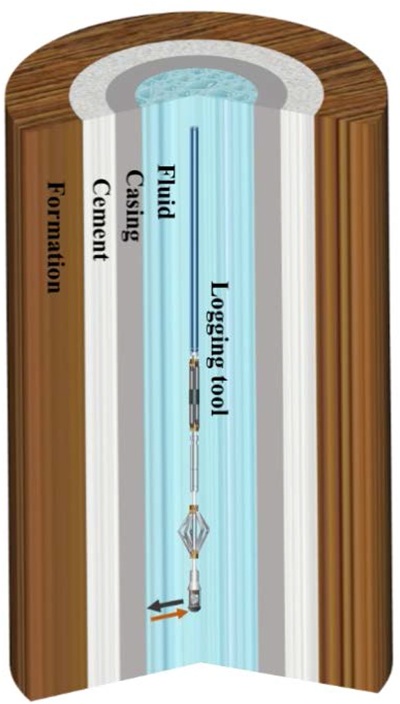 Schematic diagram of ultrasonic pulse-echo device in a cased-hole environment. Source: aiig.2025.100170
Researchers in China recently conducted a review of ultrasonic pulse-echo and pitch-catch logging techniques that have emerged as effective and non-destructive methods for such quantitative assessments. The technologies covered in Artificial Intelligence in Geosciences include automated waveform quality control using variational autoencoders, simultaneous inversion of borehole-fluid and cement acoustic impedance.
Advances are also evident in approaches that suppress casing reflections via phase-shift interpolation and F–K transforms, and joint inversion of tool trajectory and borehole properties under eccentric conditions. Machine learning-based enhancement and arrival-time picking for time interval error (TIE) waveforms are cited as developments that enable more accurate extraction of TIE and support high-fidelity inversion of cement and fluid acoustic properties.
According to the researchers from the University of Electronic Science and Technology of China, Xi'an Shiyou University and China Oilfield Services Limited, "These approaches have been validated using synthetic simulations, full-scale physical experiments, and field case studies, demonstrating robustness across varied borehole environments and well conditions. Machine learning further increases reliability and automation, particularly in complex wavefields and low signal-to-noise settings."
