
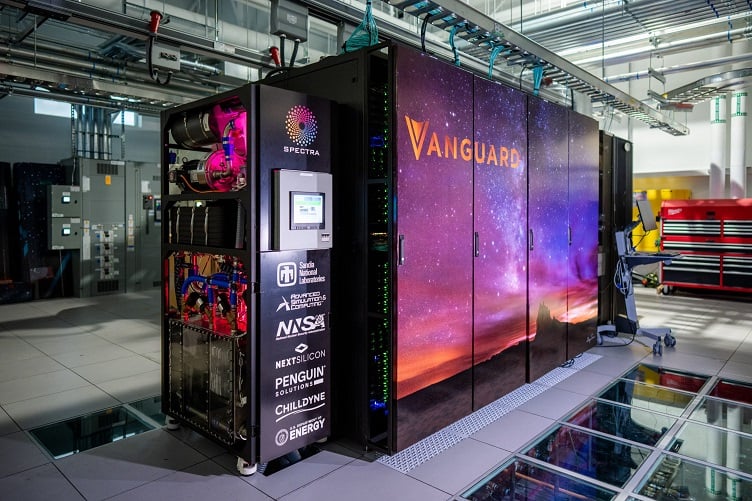
Researchers at Sandia National Laboratories have unveiled their latest supercomputer that will work on national security-related tasks like nuclear deterrent missions.
Called Spectra, the supercomputer is built in conjunction with NextSilicon and includes 128 of NextSilicon’s Maverick-2 dual-die accelerators — semiconductors that analyze code to prioritize tasks in real time.
Ultimately, Sandia is looking at the supercomputer to handle tasks like advanced fluid dynamics simulations, which help assess the safety and reliability of the U.S. nuclear deterrent without underground testing.
“We have deployed a first-of-its-kind computing capability,” said James Laros, senior scientist and Spectra project lead at Sandia. “And it’s the result of this tremendous partnership between the national labs and industry.”
If the supercomputer is successful, the research could forge a path toward more sophisticated simulations, Sandia said.
The design
Spectra’s design is different from traditional computers that feature CPUs and GPUs with the potential payoff an increased performance and reduced power consumption of supercomputers.
Sandia said Spectra is the first supercomputer to incorporate this chip architecture of 128 dual-die accelerators.
The supercomputer is the second platform deployed as part of Sandia’s Vanguard program, which is designed to explore emerging technologies for defense missions.
“By deploying prototype systems, we investigate whether new technologies can be integrated into our large production platforms in the coming years,” said Simon Hammond, director of the Office of Advanced Simulation and Computing and Institutional Research and Development Programs at the National Nuclear Security Administration.
The design could save months to years of work researchers normally spend optimizing software or hardware. This will make defense programs more agile and save money along the way, Sandia said.
Sandia said Spectra will serve as a testbed for computing breakthroughs that do not necessarily come from bigger machines but from more adaptive designs.
