
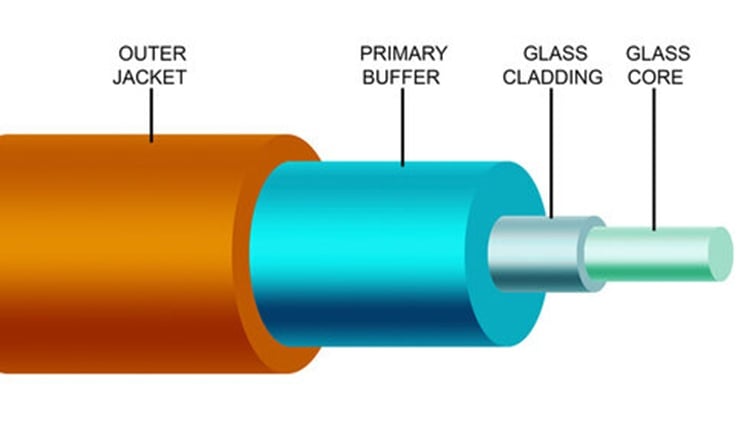
Fiber optic technology is the backbone of modern digital infrastructure, and recent innovations are propelling its capabilities to new heights. In the past few years, breakthroughs in materials, multiplexing techniques and network design have significantly boosted bandwidth, slashed latency and improved signal integrity for optical networks. These advances are not just theoretical — they are being applied in the real world, from global telecommunications backbones to local fiber deployments. Industry leaders and researchers worldwide are collaborating to enhance fiber performance, ensuring that networks can meet the exploding data demands of artificial intelligence (AI), cloud computing, smart cities and beyond. This article explores key innovations and their applications across telecommunications, data centers, smart urban infrastructure, industrial internet of things (IIoT) and healthcare sectors.
Breakthroughs in fiber materials and design
One of the most striking recent advancements is the development of hollow-core fiber (HCF) cables that guide light through an air-filled core instead of solid glass. By replacing glass with air, HCF allows light to travel much faster — about 50% faster than in standard fiber — which translates to roughly one-third lower latency. Lumenisity (a spinoff from the University of Southampton) pioneered commercial hollow-core fibers, and their technology impressed industry giants like Microsoft, which acquired Lumenisity in 2022 to improve cloud network speed and security.
HCF benefits include not only lower signal delay but also broader signal spectrum and reduced signal distortion, since light in an air core suffers fewer nonlinear effects. Real-world trials are validating HCF: for instance, Comcast tested a 40 km hollow-core link for metro networking, and financial firms are eyeing HCF for low-latency trading networks. Even healthcare applications stand to gain — Microsoft notes that HCF’s capacity and speed can accelerate massive medical image transfers and enable real-time telemedicine in cloud platforms.
Another major innovation in fiber design is the multi-core fiber (MCF) — essentially multiple optical fiber cores bundled within a single fiber strand. By sending data through many cores at once (spatial division multiplexing), MCF multiplies capacity dramatically without increasing cable size. In 2025, researchers in Japan achieved a world-record data rate of over 1.02 petabits per second (1,020 Tb/s) across a novel 19-core fiber, successfully transmitting this torrent of data over a distance of 1,808 km. Impressively, the 19-core fiber had the same outer diameter as regular fiber, making it compatible with standard infrastructure.
High-performance network architectures and deployments
Advances in fiber technology are only as good as the networks built on top of them. In recent years, network architects have embraced designs that maximize fiber’s strengths — high bandwidth and low latency — while enhancing reliability and flexibility. In telecommunications, a clear trend is the deployment of 400G and 800G optical transport on backbone routes, often in mesh or ring topologies that ensure no single failure can cut off service. Even in developing regions, operators are leapfrogging to state-of-the-art fiber infrastructure. Such architectural shifts indicate a move toward more software-defined optical networks, where operators mix and match components and use software control (SDN) for dynamic traffic management. The result is agile fiber networks that can quickly adapt to spikes in demand, reroute around faults, and optimize paths for latency or cost as needed.
For data center networks, fiber innovations are enabling new architectures within and between facilities. Hyperscale cloud providers are pushing fiber ever closer to servers — including technologies like silicon photonics and co-packaged optics that integrate optical transceivers directly with switching chips to reduce electrical bottlenecks. Inside data centers, 100G and 400G optical links are now commonplace, and 800G pluggable modules are emerging to connect AI training clusters and storage arrays at blistering speeds. Between data centers, companies like Microsoft and Google invest in private fiber routes and submarine cables, often deploying the latest optical transport tech to link their global cloud regions.
Meanwhile, service providers like Verizon have trialed all-optical switching in the metro, and startups are exploring optical mesh networks within data centers to cut down hop latency for east-west traffic. The overarching architectural theme is leveraging fiber’s raw capacity by eliminating unnecessary conversions (electrical-optical) and by distributing intelligence to the optical layer. This not only boosts performance but also reduces latency variability — vital for latency-sensitive workloads like high-frequency trading or real-time analytics.
Even smart city and industrial networks are benefiting from new fiber-centric architectures. City planners are adopting fiber backbones to connect IoT sensors, traffic control systems and public Wi-Fi, often in resilient ring configurations. Fiber’s high bandwidth and immunity to electromagnetic interference make it ideal for linking thousands of HD cameras or smart streetlights streaming data in real time. Some cities operate open-access fiber networks where multiple service providers and city services share the same physical fiber through virtual network slicing. For example, smart city projects in the U.S. (such as SiFi Networks’ FiberCity initiatives) are building citywide open fiber grids that support municipal services, 5G small cells and private business connectivity concurrently on a shared infrastructure.
IIoT settings like smart factories and utilities are also leveraging fiber for deterministic, low-latency communications. In manufacturing, fiber Ethernet rings connect programmable logic controllers and machine vision systems with microsecond precision, enabling coordination of robots on assembly lines. Power grid operators use fiber optic cables along transmission lines not just for communications, but also as distributed sensors (via fiber Bragg gratings) to detect strain or temperature changes in critical infrastructure. These architectures underscore a key point: new fiber technology isn’t deployed in isolation — it is intertwined with intelligent network design to deliver end-to-end performance improvements for communities and industries.
Conclusion
Recent innovations in fiber optics are truly pushing the limits of data transmission, ensuring that our networks keep pace with an ever-expanding digital universe. Higher-bandwidth fibers (through new core designs and multiplexing), lower-latency pathways (via hollow-core and smarter routing), and stronger signal integrity (thanks to advanced materials and AI-driven management) are together laying the groundwork for the next generation of connectivity.
