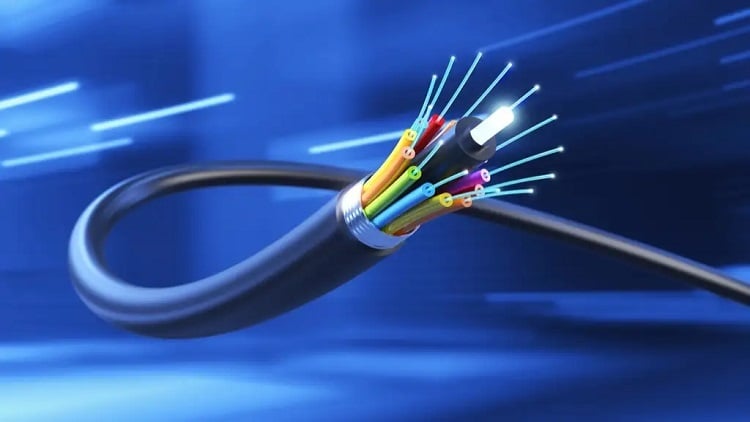
Optical fiber, sometimes referred to as fiber optics, is a technology that uses pulses of light to convey data along a glass or plastic fiber. The amount of glass fiber that makes up a fiber optic cable can range from a few dozen to several hundred. Thanks to the disparity in refractive indices between the core and the outer cladding, light is captured and directed down the fiber's core in optical fibers, allowing them to carry light signals through the principle of total internal reflection.
A number of novel designs have been in the works by top fiber manufacturers to either improve capacity or decrease latency, or both, in response to the skyrocketing data needs that have been observed thus far and are anticipated to persist in the years to come. Hollow-core optical fiber and multi-core optical fiber are the two varieties that have shown the most potential in terms of practicality and will be discussed in this article; these have shown significant advancements in terms of capacity, bandwidth and speed.
Hollow-core optical fiber
Optical fibers with a hollow core, made of air instead of solid glass, are known as hollow-core optical fibers. In comparison to traditional fibers with solid glass cores, this one-of-a-kind structural design method allows for numerous performance benefits by drastically changing the fiber's light propagation characteristics.
The Index of Refraction (IOR) of the material that light passes through is a measure of how fast or slow the light is transmitted. Since air has a far lower IOR value than glass, a hollow-core fiber minimizes latency by allowing light to move faster through its core. Additionally, its air core may accommodate a wider range of wavelengths, which increases the bandwidth possibilities that could be achieved. If we want to ensure that our telecommunications infrastructure can handle large amounts of data in the future, we need more spectrum.
Early iterations of these fibers had much greater attenuation (signal loss) than conventional glass core optical fibers, but with some manufacturers' upgrades, hollow-core fibers can now achieve the same reduced attenuation values needed for peak performance. while these have mostly been used for short-distance data center deployments so far, their potential to steadily achieve lower attenuation values could make them a good fit for widespread use in regional, metro or submarine/transoceanic transmission applications.
Key developments in design
- Photonic bandgap fibers (1990s to 2000s):
- Early versions used photonic crystal structures to confine light in the hollow core.
- Anti-resonant hollow-core fibers (2010s to present):
- Improved light guidance using anti-resonant reflecting surfaces (AR-HCFs).
- Enabled ultra-low loss and broader transmission bandwidths.
- Latency reduction:
- Light propagates 50% faster than in traditional glass fibers.
- Applications in high-frequency trading and low-latency networks.
- Ultra-low loss hollow-core fibers:
- Recent breakthroughs reduced loss below 0.65 dB/km, approaching standard fibers.
- High-power and sensing applications:
- HCFs are used in high-power laser delivery, gas sensing, and biomedical applications
Multi-core optical fiber
The second form of optical fiber known as multi-core optical fiber incorporates numerous cores into a single strand, following the design principle of space division multiplexing (SDM). Because each core is independent, a single fiber can carry numerous data streams at once. A two-core multi-core fiber effectively transmits twice as much data as a single-core fiber, and so on, thanks to the physical multiplexing capability that makes use of many cores.
Furthermore, the data transfer capacity of a single multi-core optical fiber is enhanced exponentially by employing wavelength-division multiplexing (WDM), a technique that permits the simultaneous transmission of several data channels inside a core. Reduced complexity in fiber management in dense data center environments, space savings in fiber conduits and routes, and a decrease in the total quantity of fibers and cables are all benefits of offering multiple cores within a single fiber. One simple example is the 75% reduction in physical area required when utilizing a single four-core multi-core fiber patch wire instead of four separate single-core fiber patch cables. Therefore, network architectures that are more efficient and able to handle increasing data demands while still being practically scalable can be made possible with the help of multi core fiber.
Key developments in design
- Early designs (2000s): Researchers began exploring multi core fiber to increase fiber capacity using SDM.
- Core arrangements:
- Hexagonal, square or circular configurations of cores were tested to maximize core density while minimizing crosstalk.
- Few-mode multi-core fibers emerged to balance multiplexing and core interference.
- Crosstalk reduction techniques:
- Enlarging core spacing or using trench-assisted index profiles.
- Developing low-crosstalk fiber fabrication methods.
- Optical amplification:
- Specialized multi-core amplifiers (MC-EDFA) were developed to support all cores simultaneously.
- Commercialization (2020s):
- MCFs reached over 1 petabit per second transmission speeds in research trials.
- Standardization efforts for telecom and data center applications are ongoing.
Conclusion
To sum up, optical communication is being revolutionized by two exciting technologies: multi-core and hollow-core optical fibers. Hollow-core architecture has benefits in latency and power management, whereas a multi-core architecture increases capacity via spatial multiplexing. New optical fibers for low-latency, high-bandwidth networks are sure to offer a bright future. Both hollow-core and multicore technologies are now showing performance gains that are in line with what will be required and expected in the future of data delivery.
