
A team of researchers from Hong Kong Polytechnic University has devised an approach for weaving flexible fibers that can be controlled by magnetic fields and that could potentially be used to enable robot hands to pick up fragile objects like soft fruits, potato chips and worms.
To create the smart textile, which is capable of bending, stiffening or changing its surface texture on demand, the team incorporated tiny, soft magnetic particles composed of carbonyl iron into extremely thin, flexible fibers of a low-density polyethylene (LDPE) polymer.
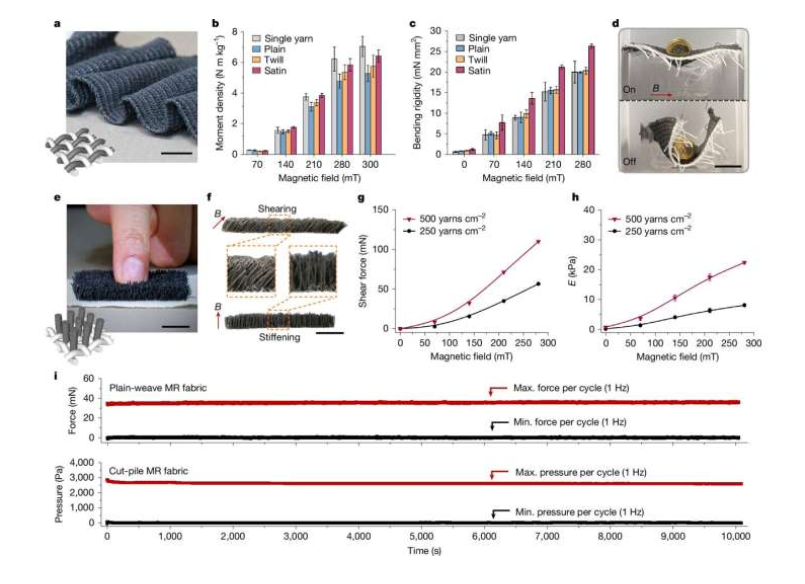 Structure and property of woven and cut-pile MR fabrics. Source: Nature. DOI: 10.1038/s41586-025-09706-4
The challenge of creating a fiber that was both thin and impregnated with magnetic materials was overcome when the researchers used a process called melt spinning, which is a high-speed technique that enabled them to produce fibers just 57 mm in diameter.
From there, the team twisted seven of the fibers together into a yarn with a helical shape that responds to a magnetic field from any direction, thus setting it apart from other smart materials.
Specifically, the helical shape imbues the material with directional control, which means it can respond to the strength and direction of the magnetic field, thereby allowing more sophisticated movements.
"Our work provides insights into stimuli-responsive fibrous materials, elevating them from scalar to sophisticated vector control, heralding an era of smart textile innovation," wrote the researchers in their paper.
The team developed two types of fabrics from the yarn — a woven textile that is ideal for bending and stretching, along with a cut-pile fabric that resembles a soft brush. Meanwhile, from the woven textile, the team produced a fabric patch that automatically opens and closes small ventilation slits in response to a magnetic field cycling on and off. This particular feature promises to manage sweat and heat instantly.
Using the cut-pile fabric, the team constructed a soft robotic gripper that, thanks to the thousands of magnetic fibers, can individually stiffen and mold around objects, thus enabling the gripper to safely and gently pick up delicate objects.
The team also used the material to build a virtual reality haptic glove that mimic real-world tactile sensations.
An article detailing the work, “Vector-stimuli-responsive magnetorheological fibrous materials,” appears in the journal Nature.
For more information, watch the accompanying video that appears courtesy of Hong Kong Polytechnic University.
