
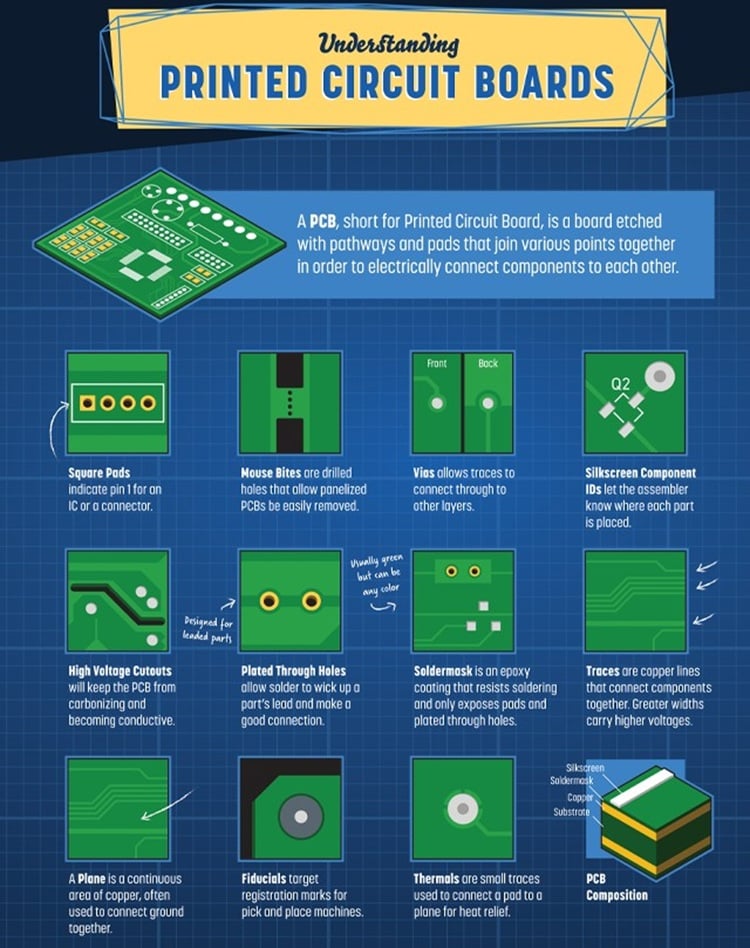
Printed circuit boards (PCBs) are the essential building blocks behind almost all modern electronic devices. These components provide electrical interconnections between electronic components, rigid support to hold components and a compact package that can be integrated into an end product. They are the main component in an electronic device that is responsible for form and function, and they allow advanced semiconductors to communicate with each other at very high data rates.
PCBs are composed of insulating materials, such as fiberglass, with conductive pathways etched onto it. These traces allow electrical current to flow between different components on the board, connecting everything into a functional circuit. Resistors, capacitors, transistors and integrated circuits (ICs) are mounted onto the board and connected through these pathways. PCBs also provide mechanical support for electronic components so that a device can be mounted in an enclosure.
Single-sided PCBs have one layer of copper for the conductive traces and are commonly deployed in low-cost electronics while double-sided PCBs allow more complex circuits. Rigid PCBs cannot be bent or flexed so as to prevent circuit board distortions. Flexible PCBs accommodate space-saving design and are of value in reducing the weight of electronic devices.
