
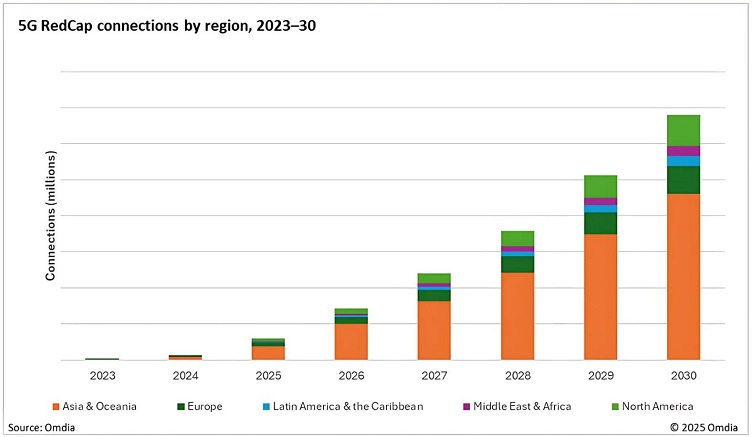
Global 5G standalone (SA) network deployments and 5G reduced capability (RedCap) adoption are accelerating with new opportunities emerging for internet of things (IoT) applications across multiple industries, according to new data from market research firm Omdia.
The firm said after numerous delays in 2024, 5G’s core promises of fast speeds, ultra-low latency and massive connectivity for industrial automation sectors and other IoT-driven sectors. The good news is that growth is likely to quicken as more options become available in the years to come.
"With 5G SA deployments picking up pace, the industry is finally realizing the true potential of 5G," said Alexander Thompson, senior analyst for IoT at Omdia. "2025 marks the first-time hardware and network ecosystems are aligned on RedCap, showcased by the recent Apple Watch launch supporting this technology."
RedCap is surging in the wake of T-Mobile’s introduction of the first North American 5G RedCap dongle. While the cost is still high, Omdia said, as prices decline, adoption is expected to grow particularly in China with government subsidies driving market growth.
Successful slicing
Omdia said another hot market for 5G is in the realm of network slicing, which has moved from successful trials to commercial offerings with T-Mobile’s T-Priority and Verizon’s FrontLine services modules.
These private 5G networks are designed to help with security concerns in IoT initiatives.
What is RedCap?
The 5G RedCap specification was released with the 3GPP standard. It is designed to provide 5G capabilities to less complex devices that also consume less power.
While smartphones use full-featured 5G chipsets, these are unable to be placed inside devices like smartwatches, augmented reality glasses and other IoT devices used for healthcare, asset tracking, smart home systems, fleet management and more.
5G RedCap core design has a maximum bandwidth of 20 MHz with a single carrier and comes without the requirement to aggregate multiple carries together. This allows for simpler and smaller antenna designs with one transmitter and one or two receivers, unlike the more complex designs required for 5G smartphones.
Not surprisingly, telecoms along with wireless equipment makers and communication vendors are looking to RedCap to expand their reach with 5G into areas that cannot be served normally with current technologies on the market.
The good news is also that 5G RedCap, while reduced in capability, still takes advantage of the benefits of the 5G network like improved bandwidth, download speeds and latency.
