
A team of researchers from the University of Virginia’s School of Engineering and Applied Sciences has developed two prototypes of insect-inspired robots that could soon glide over water, scout flooded areas, monitor pollutants or collect samples.
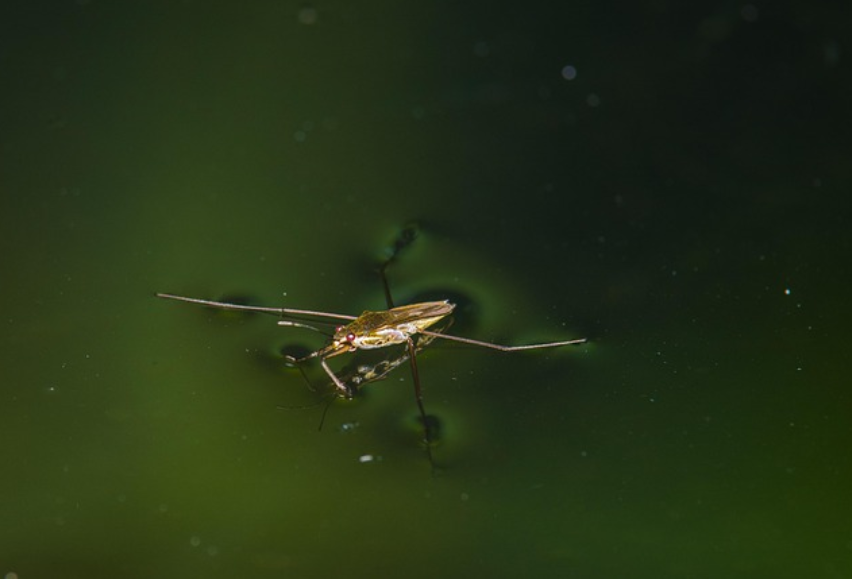
The first robot, dubbed the HydroFlexor, can paddle across water with fin-like motions, while the second robot, dubbed the HydroBuckler, “walks” forward using buckling legs, to mimic the gait of water striders.
According to its developers, the robots are both powered in the lab by an overhead infrared heater that enables them to bend and move as their layered films respond to heat. The team reportedly cycles the heat on and off to allow the robots to adjust speed and change direction.
To create the insect-inspired robots, the team employed a fabrication process called HydroSpread, which lets ultrathin polymer films develop directly on water, thereby eliminating the fragile and error-prone step often associated with transferring films from rigid surfaces.
“Fabricating the film directly on liquid gives us an unprecedented level of integration and precision,” the researchers explained. “Instead of building on a rigid surface and then transferring the device, we let the liquid do the work to provide a perfectly smooth platform, reducing failure at every step.”
The team added that droplets of liquid polymer will naturally spread into uniform sheets when deposited on the water’s surface. These sheets can then be carved with a laser into complex patterns — from circles and strips to even logos — precisely.
As such, HydroSpread enables scientists to create delicate, floating devices that would have been almost impossible to achieve using traditional fabrication methods.
Further, the elimination of the fragile transfer stage improves yield and allows for more ambitious designs in soft robotics.
Beyond the manufacture of robots, HydroSpread could also make it easier to create delicate films for wearable medical sensors, flexible electronics and environmental monitors — in other words, devices that need to be both thin and resilient, as well as capable of working where rigid materials cannot.
The robots are detailed in the article, "Processing soft thin films on liquid surface for seamless creation of on-liquid walkable devices," which appears in the journal Science Advances.
