
Roboticists from Cornell AgriTech have developed an autonomous robot that is capable of scouting for grape diseases in vineyards in near-real time, with an accuracy that is reportedly equal to highly trained human scouts.
Its developers suggest that the robot, dubbed PhytoPatholo Bot, will one day help track crop-killing pathogens with a minimal amount of labor.
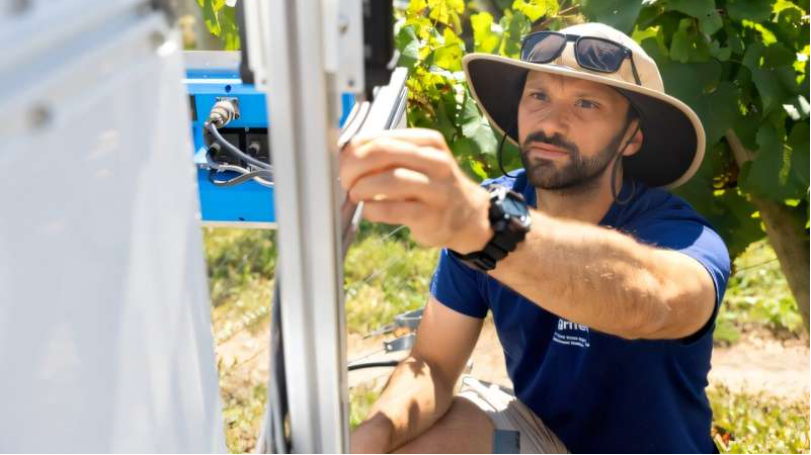 A robotics technician works on an autonomous robot designed to detect disease on grapevines on the Cornell AgriTech campus. Source: Ryan Young/Cornell University
Although disease is a critical concern for viticulturists, declining labor is also a significant challenge affecting the agricultural food industry for the past two decades.
"That's been a motivation for us: How can we use robots to do this very skilled job?" the researchers explained. "Disease scouting is not something that just anyone can do, [but now our robot] will be able to identify those critical stresses for our food systems."
The robot can self-navigate between vineyard rows of trellised grape plants. As it rolls, it captures side view canopy images and then subsequently uses an artificial intelligence (AI) model to determine within the image which pixels belong to the canopy and which pixels signal symptoms of disease.
The data from different image frames is then compared with NASA remote sensing, GPS data and computer modeling that features remote sensing images, to determine the disease risk by analyzing the spectral signatures emanating from the plants. The robot’s calculations are then sent to plant pathologists and vineyard managers in near-real time, thus revealing the type of disease, locations and infection severity within that vineyard.
In addition to saving on labor, the robot also enables the growers to target treatments.
"By having an accurate way of knowing where disease is popping up, we could mostly rely on gentler chemicals and only go with the heavy hitters when absolutely necessary," the researchers added.
An article detailing the robot, “PhytoPatholoBot: Autonomous Ground Robot for Near‐Real‐Time Disease Scouting in the Vineyard,” appears in the Journal of Field Robotics.
