
Researchers at Osaka Metropolitan University are creating autonomous agricultural robots.
According to its developers, the robots are equipped with a specialized algorithm that allows them to travel to target destinations and follow the contours of elevated planting beds.
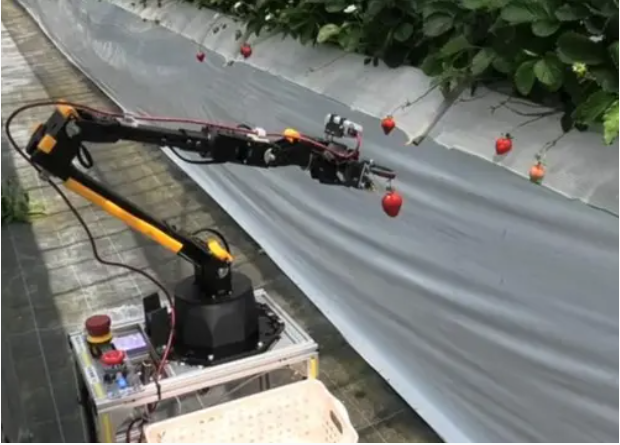 Source: Osaka Metropolitan University
Making this possible is light detection and ranging (lidar) sensors that enable the robot to scan its surroundings using laser pulses to produce detailed 3D maps known as point clouds. This offers a clear view of the terrain, plants and any obstacles, the researchers explained.
Further, the algorithm enables the robot to switch between the two navigation styles. The robot can autonomously drive to a specific location, like a harvesting zone, or track alongside a raised bed while keeping a steady, optimal distance.
As such, the robot can consistently handle the typically unpredictable layout of agricultural fields, which the team confirmed through a series of experiments in both virtual simulations and real-world strawberry fields.
During those trials, the robots maintained smooth, reliable movement even when bed heights varied or terrain conditions shifted.
The researchers also suggest that there are other use cases for such robots, thus reducing the physical burden on farm workers. “If robots can move around the farm more precisely, the range of tasks that they can perform automatically will expand, not only for harvesting, but also for monitoring for disease and pruning.”
An article detailing the team’s research, “Autonomous navigation method for agricultural robots in high-bed cultivation environments,” appears in the journal Computers and Electronics in Agriculture.
