
A new artificial intelligence (AI) algorithm capable of enabling large sets of robotic arms to work in concert in hectic industrial settings has been developed by a team of scientists at University College London (UCL), Google DeepMind and Intrinsic.
Expected to save manufacturers both time and money, the system, dubbed RoboBallet, helps teams of automated robots working in shared, obstacle-filled spaces — such as assembly lines and factory floors — to automatically and collectively plan their movements, all without colliding with each other or other objects in the environment.
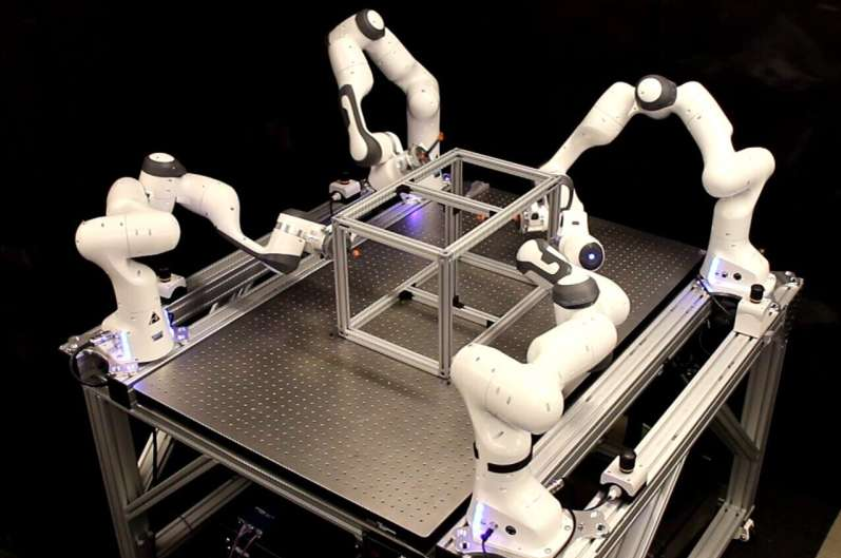 Source: UCL
Currently, this is a challenge for manufacturers that is done manually by specially trained human programmers. However, the manual process is very tedious and error-prone, taking roughly hundreds of hours for each set of tasks.
As such, RoboBallet was developed to train a graph neural network-based robot brain using reinforcement learning (RL). Through this RL framework, the robot brain reportedly learns by trial and error and is rewarded once tasks are completed. The developers explained that higher rewards are given in the event that tasks are accomplished faster.
The team explained that a graph neural network is an architecture developed to operate directly on data structured as graphs. This architecture enables the robots to better understand and reason about their surroundings — treating each obstacle as a point in a network — so they can determine the most effective way to work in concert.
During trials of the technology and following just a few days of training, RoboBallet was capable of producing high-quality plans in mere seconds. This was true, the team explained, even for complex layouts that had not been previously encountered, solving as many as 40 tasks with eight robotic arms. This reportedly exceeds the capabilities of previous systems.
"RoboBallet transforms industrial robotics into a choreographed dance, where each arm moves with precision, purpose, and awareness of its teammates. It's not just about avoiding crashes; it's about achieving harmony at scale. For the first time, we can automate complex multi-robot planning with the grace and speed of a dance, making factories more adaptive, efficient, and intelligent,” the researchers noted.
Suggesting that RoboBallet is capable of planning robot movements hundreds of times faster than real-time, the team noted that the technology could potentially enable factories to adapt instantly if a robot fails or if the layout changes. Further, RoboBallet promises to also enable layout optimization, allowing manufacturers to determine where to place robots for optimal efficiency and throughput.
The developers of RoboBallet envision the technology one day being used in applications such as car manufacturing, electronics assembly or home construction with robots.
An article detailing the team’s findings, “RoboBallet: Planning for multirobot reaching with graph neural networks and reinforcement learning,” appears in the journal Science Robotics.
For more information, watch the accompanying video that appears courtesy of UCL.
