
Researchers from Johns Hopkins University trained a robot, using videos of surgeries, to perform a phase of a gallbladder removal without human intervention.
According to its developers, the robot, dubbed Surgical Robot Transformer-Hierarchy, or SRT-H, operated on a lifelike patient, responding to and learning from voice commands issued from the team as it went.
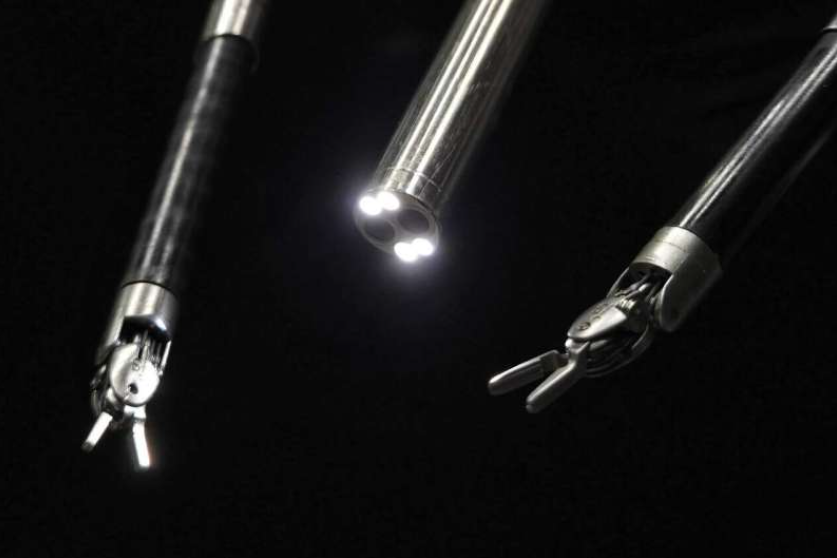 Source: XinHao Chen/Johns Hopkins University
SRT-H reportedly performed across trials and with the expertise similar to that of a skilled human surgeon, even when unexpected scenarios occurred, such as typical in real-life medical emergencies.
"This advancement moves us from robots that can execute specific surgical tasks to robots that truly understand surgical procedures," explained the researchers. "This is a critical distinction that brings us significantly closer to clinically viable autonomous surgical systems that can work in the messy, unpredictable reality of actual patient care."
SRT-H actually performs the surgery while adapting to individual anatomical features in real time. Likewise, the robot makes decisions on the fly and self-corrects when it encounters unexpected circumstances.
The team built SRT-H using the same machine learning architecture that powers ChatGPT. Further, it is also interactive and capable of responding to spoken commands and corrections. This feedback helps the robot learn.
To perform the gallbladder removal procedure, which includes a minutes-long string of 17 tasks, the robot was taught to identify specific ducts and arteries and to grab them precisely, to place clips and to sever parts with scissors.
The developers explained that SRT-H learned how to do this by watching videos of surgeons at Johns Hopkins performing these tasks on pig cadavers. The researchers reinforced the visual training by employing captions that described the tasks. Once SRT-H watched the videos, it could perform gallbladder surgery with 100% accuracy.
While SRT-H took longer to perform gallbladder surgery than a human surgeon, the final results were comparable to a veteran surgeon.
The findings are detailed in the article, “SRT-H: A hierarchical framework for autonomous surgery via language-conditioned imitation learning,” which appears in the journal Science Robotics.
