
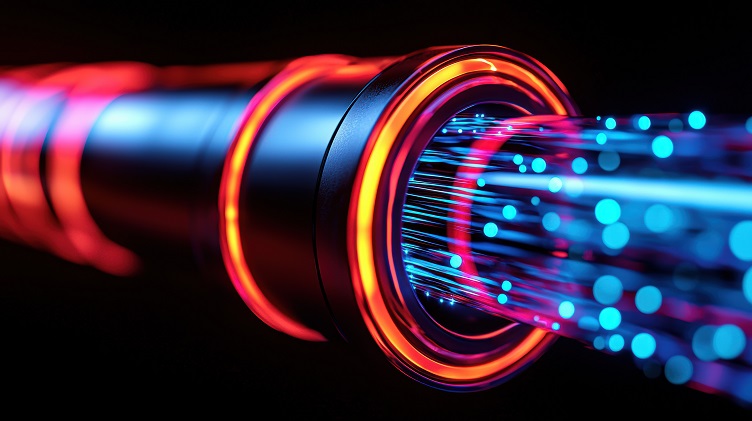
Photonic sensors are transforming how industries measure the world — using light to detect changes in physical, chemical and biological systems with speed, precision and without physical contact. With high sensitivity and rapid response times, they are uniquely suited for environments where traditional sensors fall short.
From fiber optic gyroscopes in aerospace applications to biosensors used in medical diagnostics, photonic sensors have proven both reliable and effective. Yet, despite their promise, they face limitations. Namely, high manufacturing costs, signal degradation over long distances, and sensitivity to environmental interference. These challenges — most particularly the cost — often restrict their adoption, confining them to specialized and high value applications.
However, recent advances in materials science have begun to deliver integrated photonics, where waveguides and optical devices are fabricated as an integrated structure onto the surface of a flat substrate. This allows them to be used in ways like integrated circuits — and even to be manufactured in electronics FABs. Data processing technologies are also reshaping the landscape of photonic sensing, making such devices more accessible, precise and versatile.
Among the most exciting developments in photonics are those in fiber optic sensing, allowing distributed discrete device sensing.
Photonic breakthroughs
One of the most significant breakthroughs for photonic sensing has been the development of silicon-based photonics. Previously, these sensors relied on bulky and expensive optical components, including polished lenses, limiting their scalability and affordability.
Silicon photonics, which integrates optical components directly onto semiconductor substrates, has revolutionized the field by making it possible to manufacture photonic sensors using CMOS fabrication techniques in existing FABs. This advance has fundamentally altered costs while also improving physical complexity, reliability and integration with electronic systems.
In environmental monitoring, silicon photonic sensors are now being deployed for real-time detection of air pollutants, offering previously unachievable levels of both sensitivity and miniaturization, at rapidly declining cost.
An unrelated but equally transformative advance has come from the development of plasmonic sensors. Harnessing the properties of surface plasmons, electron oscillations that occur at the interface of metals and dielectrics, in the form of surface plasmon resonance (SPR) or localized surface plasmon resonance (LSPR) effects.
These sensors achieve exceptional sensitivity to molecular interactions, such as adsorption. This makes them ideal for applications in medical diagnostics, particularly in detecting biomarkers for diseases at remarkably low concentrations. Recent developments in plasmonic sensors, enhanced by machine learning algorithms, are being used to identify cancerous cells at earlier stages than previously possible, improving patient outcomes and opening opportunities in diagnostic medicine.
Advances in fiber optics are also helping to push the boundaries of photonic sensing. Distributed fiber optic sensors, exploiting optical fibers as both transmission lines and sensing elements, are improving structural condition-monitoring in buildings and infrastructure. These sensors can enable detection of minute changes in strain, temperature and vibration along the length of a fiber, making them invaluable for monitoring bridges, pipelines and power grids. Phase analysis can even pinpoint the changed position along the fiber length.
Unlike conventional sensors that provide discrete data points, fiber optic sensors offer continuous monitoring over extended length/area, improving predictive maintenance capabilities and early warning of incipient failures.
Quantum-enhanced photonic sensors represent another frontier in the field. By exploiting quantum entanglement and squeezed light techniques, these sensors surpass the previously understood fundamental limits of precision, enabling detection of gravitational waves, magnetic fields and even neural activity with unprecedented detail.
In defense and security applications, quantum photonic sensors are being developed for ultra-precise positioning and navigation systems that do not rely on GPS, offering a strategic advantage in environments where satellite signals may be jammed or unavailable.
In the medical field, non-invasive glucose monitoring using mid-infrared photonic sensors is edging closer to commercial viability, potentially transforming diabetes management. In industrial automation, photonic sensors embedded in robotic systems are enabling increased real-time process monitoring, leading to smarter and more adaptive manufacturing environments.
Autonomous vehicles, too, stand to benefit from advanced lidar systems with improved resolution and range, enhancing object detection and situational awareness in complex environments.
Future developments
Within the near future, photonic sensors could rapidly transform many technologies and industries. This is being driven by a rapid pace of research and advances in materials, nanophotonics and AI analytics — both in data analysis and system design.
However, before this occurs, a few more challenges must be solved. These include limitations in sensitivity, which sometimes require signal amplification and noise reduction, which can alter measurements. Environmental factors like temperature, humidity and electromagnetic interference can also impair the sensors, even though they excel in chemical environs.
Furthermore, design engineers must learn how to integrate them into current and new products, since they are largely ignored when suitable, more convenient electric sensing technologies are available.
The gulf to be crossed, from specialized scientific instruments to mainstream technological components is closing fast, promising a future where the ability to control, measure and secure the power of light sensing is creating whole new pathways in science, technology, product and biology.
From enhancing security and safety to enabling both novel and increasingly precise medical diagnostics and driving innovations in autonomous systems, photonic sensors are redefining the way systems, materials, components, chemical reactions and the environment are measured.
