
China-based tech firm DEEP Robotics has developed a wheel-legged robot for industrial inspection and emergency operations in unstructured environments.
According to its developers, the LYNX M20 combines the terrain agility of legged robots with the speed of wheeled systems to accomplish inspection tasks in sectors such as power distribution, utilities and urban safety.
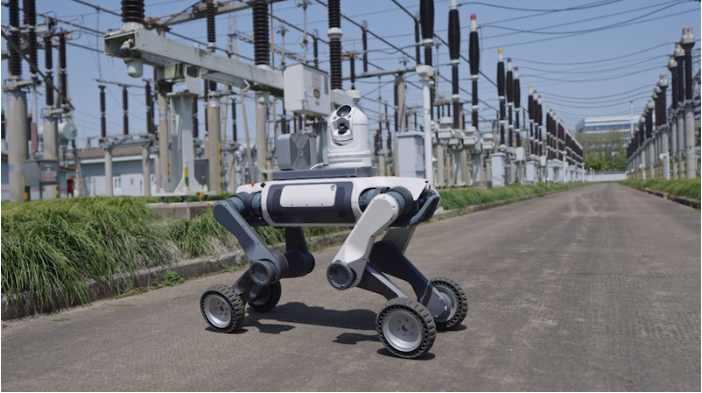 Source: DEEP Robotics
While substations, tunnels and other critical infrastructure tend to suffer from inefficient, manual inspection routines that are susceptible to human error, the LYNX M20 tackles these issues with autonomous navigation, a 2.5-hour runtime and a 15 km range while carrying a payload of up to 50 kg of inspection equipment.
The LYNX M20’s design features include a front-elbow-rear-knee joint system that enables bidirectional movement, night-vision support and the ability to navigate 50 cm-wide spaces.
Further, the LYNX M20 robot is rated IP66 for dust and water resistance and is capable of operating in extreme temperatures ranging from -20° C to 55° C, making the robot appropriate for harsh environments, including deserts or freezing substations.
Additionally, the LYNX M20 uses simultaneous localization and mapping (SLAM) technology with 96-line lidar and a 360° × 90° field of view for 3D terrain mapping and real-time obstacle avoidance.
The robot is also outfitted with dual-spectrum cameras and sensors, making it possible for the LYNX M20 to detect thermal anomalies, gas leaks and abnormal mechanical sounds, thereby enabling maintenance teams to identify and respond to faults.
DEEP Robotics also envisions that the LYNX M20 could one day be used for firefighting, last-mile logistics and urban management applications.
