
A research team in Switzerland has developed a robot capable of autonomously transporting cargo across both flat and uneven terrain. Named LEVA, the robot combines wheeled and legged movement and is designed to carry standard cargo boxes without human assistance. The system was developed by ETH Zurich and partner institutions and is being commercialized by RIVR, a spin-off company. LEVA is currently in prototype phase.
Hybrid robot designed for cargo handling
Developed by ETH Zurich and Partner Universities
LEVA is a product of collaboration between ETH Zurich, the Zurich University of Applied Sciences (ZHAW), and the Zurich University of the Arts (ZHdK). It has been transitioned into a commercial venture under RIVR, formerly known as Swiss-Mile.
 Source: Qviro
Intended for unstructured and mixed-terrain environments
Unlike conventional delivery robots that rely solely on wheels, LEVA integrates four legs with wheels at the end of each limb. This allows it to roll efficiently on flat surfaces and walk over stairs or rough ground when required.
Payload capacity and operation
Handles up to 85 kg autonomously
LEVA is designed to pick up and transport Euro-type cargo boxes weighing up to 85 kilograms. It uses a series of cameras and onboard sensors to identify a box, position itself over it and secure it using internal locking hooks. The robot then lifts the box and begins its journey.
Autonomous navigation and object handling
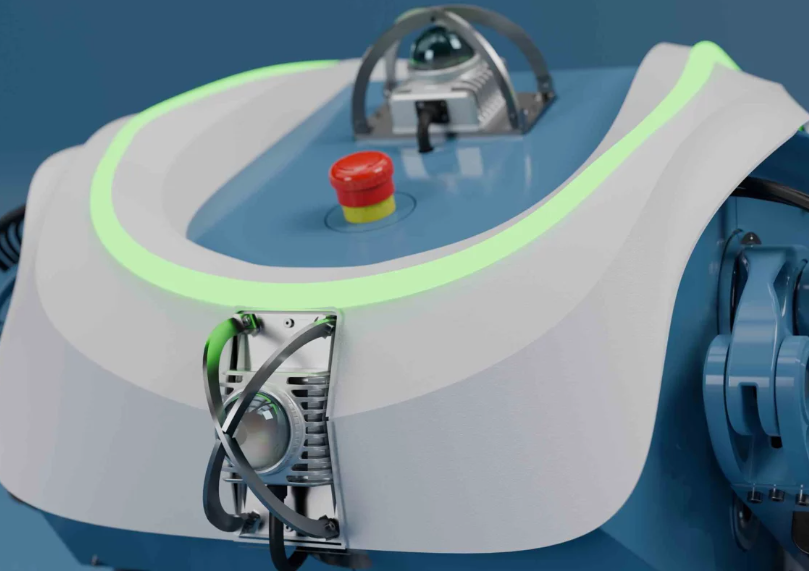
The robot navigates using a combination of GPS, lidar and five cameras, including one on its underside. Each of its wheels is independently steerable, allowing it to move forward, backward, sideways or rotate in place for precise positioning.
Technical specifications
Dimensions and payload
LEVA measures 1.2 meters in length and 0.75 meters in width, with an adjustable height ranging between 0.6 and 0.9 meters. The robot itself weighs 85 kilograms, which matches its maximum payload capacity of 85 kilograms. This enables it to carry standard Euro-type cargo boxes without exceeding its own weight, ensuring balance and mobility during transport.
Mobility and sensing
The robot moves using four jointed legs, each equipped with powered, steerable wheels. This hybrid system allows for two types of movement: omnidirectional rolling on smooth surfaces and legged walking over stairs or uneven ground. For autonomous navigation and obstacle avoidance, LEVA is equipped with GPS, lidar and five onboard cameras, including one mounted underneath the robot for ground-level visibility.
Real-world deployment timeline not confirmed
There is no announced schedule for commercial release. Further testing and validation are expected before it sees operational use in real environments.
Potential use cases
Suitable for logistics and facility delivery
LEVA is designed for environments that mix indoor and outdoor access or involve obstacles such as stairs and uneven surfaces. Potential settings include:
- Large warehouses or campuses
- Urban last-meter delivery
- Material transport in facilities with limited accessibility
Not designed for fixed industrial automation
LEVA is not intended for tasks such as assembly line integration or repetitive industrial work. Its design focus is on mobile payload transport rather than factory automation.
Outlook
LEVA highlights the growing trend toward mobile robots that can handle diverse environments without human input. While still under development, its leg-wheel hybrid design could serve as a model for future autonomous systems intended for logistics and facility operations.
