
Researchers from North Carolina State University have created a light-powered soft robot that can transport loads through the air along pre-established tracks, much like cable cars or aerial trams.
According to its developers, the soft robot operates autonomously, climbs slopes at angles of up to 80° and transports payloads up to 12 times its weight.
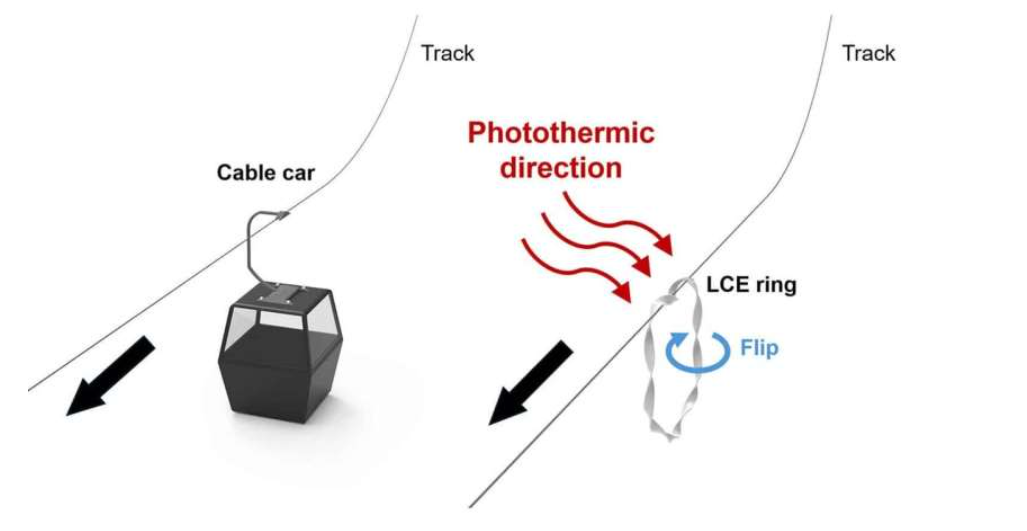 Source: North Carolina State University
"We've previously created soft robots that can move quickly through the water and across solid ground, but wanted to explore a design that can carry objects through the air across open space. The simplest way to do this is to follow an established track — similar to the aerial trams you see in the mountains. And we've now demonstrated that this is possible."
The robots are composed of ribbon-like liquid crystal elastomers that are twisted and then joined at the end to create a loop that looks like a bracelet. The team noted that this "soft ring robot" is suspended on a track, which can be made of a thread, wire, cable or other material. The same ring is looped around the track two or three times, which enables the ring to hang at an angle parallel to the track.
With an infrared light source located perpendicular to the track, the piece of the ribbon absorbing the most light will contract. This creates a rolling motion wherein the portion of the ribbon exposed to light contracts, pulling the "cooler" piece of the ribbon into the light, which then heats up as the first section cools, encouraging the cycle to repeat itself. While the soft ring rolls and twists on itself, it propels itself along the track.
"As the ribbon turns, it's like turning a screw, allowing the soft robot to move along the track — even when carrying cargo up steep angles," the researchers explained.
The team demonstrated that the soft ring robot could travel along tracks as thin as a human hair, or as thick as a straw. Additionally, the soft ring robot was capable of overcoming obstacles on the track, like knots or bulges.
"We also showed that it can follow complex routes — it doesn't have to be a straight line. We've demonstrated that it can follow curved lines, circles, three-dimensional spirals, and so on, in a controlled way. We think the adaptability of the robot when it comes to navigating complex patterns in predictable ways holds promise for its utility in practical applications, We're now thinking about specific applications for this technology, as well as adapting the soft robots to respond to inputs other than infrared light," the team noted. "For example, developing a soft ring robot that operates in sunlight or in response to other external energy sources."
An article detailing the robot, "Aerial Track-Guided Autonomous Soft Ring Robot," appears in the journal Advanced Science.
For more on the soft ring robot, watch the accompanying video that appears courtesy of North Carolina State University.
