
Dolphins have an amazingly precise echo location system that allows them to focus on a small area when hunting for food. The Dolphin Research Center (DRC) in the Florida Keys is designing a project using an array of 15 hydrophones to listen to the dolphin’s sonar clicks. The signals are captured with a 16-channel digitizer system by Spectrum Instrumentation. The data is then processed using a custom artificial intelligence (AI) program to determine, from the different signals, the location the dolphin has focused on. In a second step, at the end of this year, this setup will be used to control a cursor on an underwater screen. The dolphins can then move the cursor and see the results.
Jesse Fox, director of IT at the DRC, explained, “I am passionate about this project because it will open up many more avenues of communication. Currently, we are limited in objective methods of gathering responses from the dolphins to stimuli or, ‘questions’ if you will. The concept behind this new setup has been around for a few years, and it’s the equivalent of pressing a button but on a much higher level. A real-time moving cursor, that is guided by a dolphin, will open a whole new area of animal cognition and understanding of dolphins! We hope to reach this stage by the end of 2025, and the first thing I want to do then is to write a paint program for the dolphins to play with!”
The project recently changed its digitizer cards because the previous ones gathered too much data, creating a buffering issue that prevented real-time data processing. “The Spectrum cards capture the perfect amount of data needed to pinpoint the echo location information and, crucially, gather enough ambient sounds for the AI to parse them out. We use Spectrum’s SBench 6 software to control the cards, which is really easy to set up and use,” said Jesse Fox.
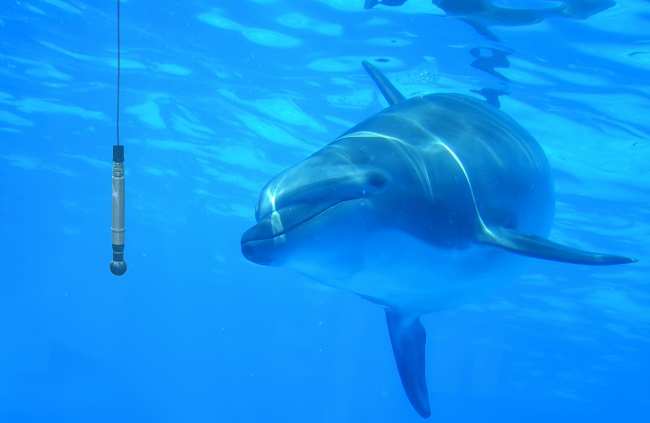 A combination of hydrophones, digitizers and a custom-developed AI is able to locate the focus of the dolphin’s sonar clicks. Source: Spectrum Instrumentation
Two Spectrum M2p.5913 digitizer cards, each with 5 MS/s sampling speed, eight channels and 16-bit resolution, are connected together via a Spectrum Star-Hub module to ensure they are perfectly synchronized. This allows the processing of the 15 hydrophone signals to precisely determine the spot on which the dolphin has focused its echo location on. The large on-board memory of the ADC cards can gather and pass on the data for processing without any buffering. It is projected that this will deliver more than 8 TB of data per week that will be uploaded to Google Drive for later analysis and training of the AI.
An obvious problem is that humans cannot show dolphins how to move the cursor. Fortunately, dolphins are incredibly curious and can be asked to echo locate in a particular place. The plan is to encourage this, let them experiment and see what happens. Juvenile males are particularly good at this and should be able to learn for themselves how to move the cursor on the screen. Dolphins also learn from each other, so they will soon hopefully pass this new skill on to the other dolphins.
After the initial paint program, Fox plans to create numerous games to entertain and enrich the lives of the dolphins. “They are so much like us and yet so different,” he commented. “This project will enable us to better understand how they think.” He added that the dolphins have different interests and motivations, and, as with humans, this varies from individual to individual. One example of this is an experiment where two dolphins had to press a button with their snouts at roughly the same time to release some fish. Once the pair had worked this out, one stopped participating on her own as there was no praise from a human, which was her motivator more than food. “After all, a star needs her applause,” Jesse explained.
