
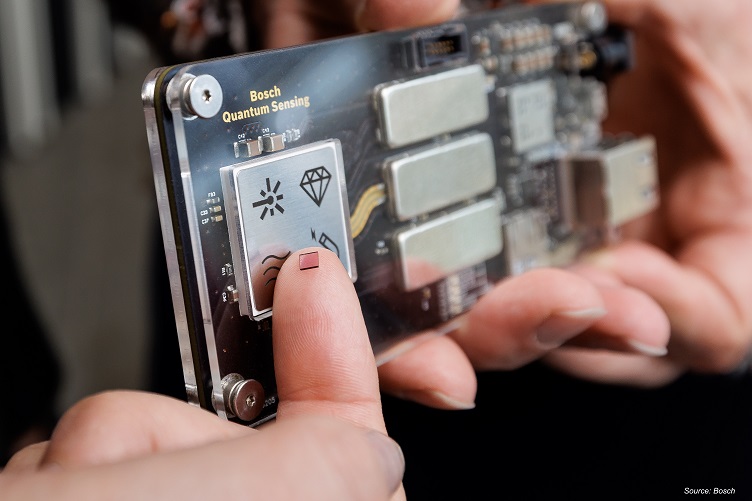
German chipmaker Bosch is establishing a joint venture (JV) with synthetic diamond provider Element Six to accelerate the development of quantum sensors.
Called Bosch Quantum Sensing, Element Six will take a 25% stake in the JV and its synthetic diamonds will be a key component in the quantum sensors that will be pushed toward commercialization about the middle of next decade. A market that Bosch claims will enable medical and mobility applications in the single-digit billion Euro range per year.
Commercialization
Synthetic diamond is a wide bandgap (WBG) material — like silicon carbide (SiC) and gallium nitride (GaN) — that potentially could be a game-changer for power systems, next-generation electronics and communication devices.
While GaN and SiC are gaining traction in the semiconductor market, synthetic diamonds are not nearly as mature and will grind toward mainstream over the next decade.
Using this material will allow quantum sensors to detect even the tiniest magnetic fields.
Bosch said the material will enable it to produce quantum sensors at industrial scale and integrate the material into scalable sensor systems for the next generation of applications.
Bosch has developed a quantum sensor prototype that is about the size of a smartphone. So, the technology has a long way to go before it can be used in other applications.
The next steps
Bosch said it is working on reducing the size of the quantum sensors so that they can be integrated into another integrated circuit. The compact sensors will be highly portable, less expensive to produce and have better scalability.
Bosch explained that once the quantum sensor can be integrated onto a chip, it could be used for robust navigation, complementary to conventional GPS systems. It could also be used for the exploration of nature resources or in healthcare for the measurement of cardiac activity.
What are synthetic diamonds?
Synthetic diamonds are an alternative integrated circuit material that can withstand very high voltage due to its physical properties. Synthetic diamond material is purportedly better than silicon for high voltage, meaning it would require 30 times less material thickness to hold the same voltage as silicon.
Element Six said that heat dissipation is also an advantage as it is five times better at it than copper. As power devices generate significant amounts of heat, it must be dissipated to maintain performance, which means usually bulky cooling systems. Synthetic diamond materials could reduce the size and weight of the cooling systems by as much as 80%.
Other benefits include:
- Improved energy conversion efficiency to 99%.
- Increased autonomy by nearly 10% without changing the battery.
- An estimated 10 times reduction in CO2 levels compared to SiC, 100,000 times less than silicon.
