
A solution for boosting battery life for small electronics has been developed by Nordic Semiconductor in the form of the nPM2100 power management integrated circuit (PMIC). The device is engineered to improve the efficiency and life span of disposable, non-rechargeable batteries.
While rechargeable batteries are crucial components of consumer electronics, disposable batteries still represent a major portion of power sources, with some projections showing that up to 78 million batteries will be disposed of each day in 2025. The new PMIC could play a key role in maximizing the usage of the limited energy in each battery.
The nPM2100 manages the power supply for low-power systems-on-chip (SoCs) or microcontrollers (MCUs) such as Nordic’s nRF52, nRF53 and nRF54 series advanced wireless multiprotocol products. The PMIC is optimized for maximum efficiency and compact size and is configurable through an I2C-compatible Two Wire Interface (TWI). This interface enables easy access to configure a range of advanced functions, including ship mode and accurate battery fuel gauging. The PMIC also features two GPIOs that can be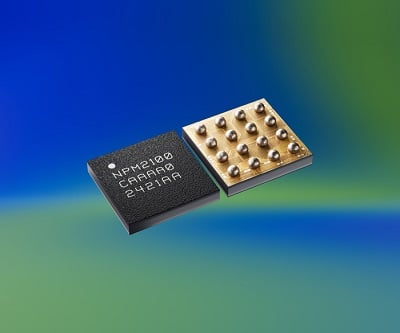 Source: Nordic Semiconductor repurposed to direct control lines to time-critical control functions as an alternative to serial communication.
The nPM2100 targets primary battery applications. Examples of supported batteries are one or two AA/AAA/LRxx batteries (in series), or one 3 V lithium manganese dioxide cell. Single- or dual-cell silver oxide and zinc-air coin-cell batteries are also supported, plus any other primary battery that operates within the nPM2100’s input voltage range.
The nPM2100 features a boost regulator with an output range of 1.8 V to 3.3 V, powered from an input range of 0.7 V to 3.4 V. The regulator can deliver up to 150 mA maximum current. The regulator also powers a load switch/LDO supplying up to 50 mA across an output range of 0.8 V to 3.0 V. The regulator features a quiescent current (IQ) of 150 nA and delivers up to 95% power conversion efficiency at 50 mA and 90.5% efficiency at 10 µA, making it one of the most efficient contemporary boost regulators available
Low current ship- and hibernate-modes
The nPM2100 PMIC features a low current ship mode that enables products to be transported with the battery inserted. The ship mode supports a 35 nA sleep current with multiple wakeup options, including a patent-pending ‘break-to-wake’ function. This function allows a buttonless product to wake up from ship mode when an electrical connection is broken.
The PMIC also features an ultra-low power wakeup timer that can run concurrently with ship mode to allow timed wakeups. The timer can be used for a deeper sleep setting than the power-off of a SoC or MCU can provide. The nPM2100’s total current draw in hibernate mode is less than 200 nA. Such a low current draw can extend the battery life of applications that use sporadic Bluetooth Low Energy (LE) advertising — for example, sensors in a sensor network — by up to three times.
In the case of Nordic’s lowest power wireless SoC, the nRF54L15, waking up periodically to do a Bluetooth advertising, listed below are the battery life improvements expected from the nPM2100’s hibernate mode compared to using the lowest power timed standby mode of the SoC:
- 2.5-minute wakeup intervals: 25% longer battery life
- 4-minute wakeup intervals: 50% longer battery life
- 9-minute wakeup intervals: doubled battery life
- 60-minute wakeup intervals: tripled battery life
Precise algorithm-based fuel gauging
The nPM2100 supports precise algorithm-based fuel gauging, a feature not commonly found in PMICs for primary-cell batteries. The common method for estimating remaining energy consists of measuring the battery voltage and using a discharge curve-derived look-up table to estimate remaining energy is inaccurate and often leads to end-users replacing batteries before they are depleted, or worse — running out of battery unexpectedly. In contrast, the nPM2100 supports a voltage and temperature-based fuel gauge running on the host microprocessor that enables more accurate battery level measurements and enables users to access all the energy in the battery with confidence. The software-based fuel gauge places minimal additional load on the battery.
