
Pickering Interfaces has recently launched a family of PXI and PXIe programmable resistor modules that it says are its first with the capability to handle up to 2 A and 200 V, or as limited by max power. Part of the company’s expanding range of medium- to high-power resistor modules, the new PXI (model 40-254) and PXIe (model 42-254) products follow on from the company’s 2.5 W (model 40-251), 5 W (model 40-252), and 10 W (model 40-253) modules. They are designed to provide a compact and simple solution for applications requiring 1 or 2 resistance channels, with up to 15 W of power handling capability per channel. The 42-254 range is also the first medium-power module available in PXIe format.
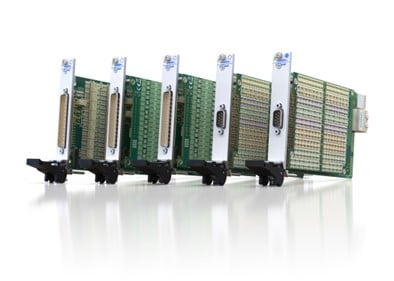 Pickering says its new family of PXI and PXIe programmable resistor modules are its first with the capability to handle up to 2A and 200V, or as limited by max power. Source: Pickering Interfaces According to Pickering, programmable resistors are designed to simulate resistive sensors and variable resistors in systems when testing devices such as electronic controllers. The 40/42-254 family is available in a variety of resistance ranges and resolution capabilities — from 0.125 Ω to 8 Ω resolution and from 1 Ω to 395 kΩ range — to meet the needs of most functional test systems. For added test coverage, each channel can simulate short- or open-circuit conditions caused by faulty wiring or sensors within a system.
In addition, resistor value calls are used to simplify software control: The module calculates the resistance setting closest to the requested value and sets that value. The user can then interrogate the module to find the actual setting used. To help ensure long-term accuracy, a calibration cable assembly can also be attached to the module in place of the unit under test (UUT), enabling simple calibration using a digital multimeter (DMM) to verify the resistor channels.
To suit the most common configurations, Pickering has made the new resistor modules available in 28 standard builds that include narrow resistance range, with one- and two-channel variants; medium resistance range, with one-channel variants; and wide resistance range, also with one-channel variants. Depending upon the variant, each module comprises a mother- and daughterboard or a motherboard only. These are populated with resistor chains, which are switched via two-pole electromechanical relays. User connection is via a front panel male 9-pin D-type connector.
