
An amplifier is an electronic device that increases the magnitude of a signal, typically a voltage or current. It takes in a weak electrical signal, like a small voltage signal from a microphone; uses an external power to boost the signal's strength; and produces a larger replica of the input signal. This amplified signal can be used to drive speakers, headphones or other devices. Regular amplifiers have their uses, but they fall short in certain situations, especially when dealing with signals from sensors. However, instrumentation amplifiers (in-amps) excel at amplifying these weak signals while filtering out electrical noise from the environment.
How does an in-amp work?
Unlike a regular amplifier that amplifies any voltage on its input, an in-amp focuses on the difference between its two main inputs (positive and negative). This makes it ideal for extracting weak sensor signals having a common noise voltage affecting both inputs. It also has a very high input impedance. This means it draws minimal current from the sensor, preventing it from affecting the sensor's output signal. Such capability crucial for maintaining the integrity of the weak sensor signal.
It rejects common-mode noise, which is an electrical noise that appears on both the positive and negative inputs of the in-amp with the same amplitude and phase. The in-amp cancels out this common noise, amplifying only the differential signal (the voltage difference between the inputs) that carries the actual sensor data.
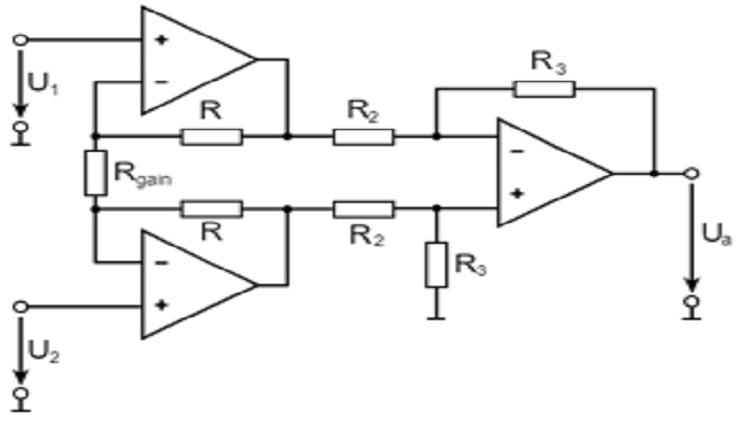
Internally, an in-amp often uses a configuration of three operational amplifiers (op-amps). The first stage typically consists of two high-impedance op-amps in a differential configuration, amplifying the voltage difference between the inputs. The third op-amp acts as a high-gain output stage to further amplify the differential signal. A key advantage of in-amps is their precise and adjustable gain. Unlike differential amplifiers that require multiple resistors to set gain, in-amps typically use a single resistor (internal or external) to control the gain. This simplifies gain adjustment and ensures consistent amplification.
Which type of in-amp is suitable for specific applications?
The choice of in-amp type depends on the specific requirements of the application. Factors like the nature of the sensor signal (AC or DC), desired level of gain control, filtering needs and signal speed all play a role in selecting the most suitable in-amp for the task. The following are some common categories:
1. AC coupled vs DC coupled:
· AC coupled: These in-amps block any DC offset voltage on the input signal, amplifying only the AC component. This is useful for isolating and amplifying specific frequency bands of interest in the signal.
· DC coupled: These in-amps amplify both the AC and DC components of the input signal. This is suitable for applications where the entire signal, including its DC offset, needs to be accurately amplified.
2. Programmable gain in-amps:
· These in-amps offer the ability to electronically adjust the gain through digital control signals. This provides flexibility and dynamic control over the amplification level.
3. In-amps with integrated filters:
· Some in-amps come with built-in filters that can eliminate unwanted high-frequency noise or low-frequency drifts from the signal before amplification. This simplifies the circuit design and improves signal quality.
4. High-speed in-amps:
· Designed for applications involving fast-changing signals, these in-amps boast high bandwidths to handle rapid signal variations without distortion.
5. Low-noise in-amps:
· In situations where minimizing inherent electrical noise within the amplifier is critical, these ultra-low-noise in-amps are preferred. They ensure the amplified signal remains as pure as possible.
How in-amps differ from operational amplifiers
Functionality:
- Op-amp: Op-amps can be configured for various functions like amplification (inverting, non-inverting), voltage following, integration, differentiation and filtering by using external feedback loops.
- In-amp: In-amps are designed specifically for amplifying weak differential signals (the voltage difference between two input terminals) while rejecting common-mode noise (noise that affects both inputs equally). They are ideal for applications requiring high accuracy and noise rejection, such as sensor interfacing.
Input and gain:
- Op-amp: Typically has two inputs (inverting and non-inverting) and one output. Gain is set by external resistors connected between the inverting input and the output.
- In-amp: Usually has three inputs (two differential inputs and a reference input for common-mode adjustment) and one output. Gain is precisely controlled with a single resistor (internal or external) isolated from the signal inputs.
Internal design:
- Op-amp: A basic building block. Op-amps don't have a fixed internal configuration.
- In-amp: Often uses a three op-amp configuration. Two op-amps form a high-impedance differential input stage, and the third acts as a high-gain output stage. This design optimizes performance for differential signal amplification and common-mode rejection.
Applications
· Op-amp: Due to its versatility, op-amps find use in various circuits like audio amplifiers, active filters, signal conditioning circuits and data acquisition systems.
· In-amp: In-amps are prevalent in precision measurement systems where amplifying faint sensor signals accurately amid noise is crucial. Examples include ECG (electrocardiogram) machines, temperature measurement systems and strain gauge amplifiers.
Conclusion
Amplifiers are crucial components in many electronic devices, making faint electrical signals strong enough for our purposes. An in-amp is a specialized type of amplifier designed to address the challenges of amplifying weak signals from sensors in noisy environments. Their high common-mode rejection ratio, high input impedance, and precise gain control make them the workhorse of precision measurement systems.
